
A good SaaS SEO agency does not chase traffic. It builds pages for each stage of a long B2B buying cycle (problem, solution, comparison, integration and use case), keeps your JavaScript app crawlable, and measures demo requests and trials instead of visits. The same logic applies to industrial manufacturers and early startups: fewer searches, bigger deals, more people in the decision.
How B2B and SaaS SEO differ from local SEO
A salon in Nagpur wants calls this week. A company selling HR software or CNC spare parts wants a lead that may close in three to nine months, after a manager, a finance head and an IT person have all checked the website.
| Factor | Local or ecommerce SEO | B2B, SaaS and industrial SEO |
|---|---|---|
| Buying cycle | Minutes to days | Weeks to months, often with a trial or RFQ |
| Decision makers | One person | Several stakeholders, each with different questions |
| Search volume | Hundreds or thousands a month | Often 10 to 200 a month per keyword |
| Value per conversion | ₹500 to ₹5,000 typical | ₹50,000 to several lakh a year per account |
| Main conversion | Call, visit, order | Demo, free trial, quote request, sample |
| Best success metric | Calls and orders | Qualified pipeline and revenue from organic |
The volume and value ranges are typical estimates, not fixed figures. The point holds: a keyword with 40 searches a month can beat one with 4,000 if each lead is a ₹3 lakh annual contract. Judge a B2B SEO service on pipeline, not a traffic chart.
Several stakeholders also means several pages. The operations manager searches for the problem, the CTO checks integrations and security, and the finance head looks for pricing. A homepage and a contact form leave two of them without answers.
B2B SaaS SEO keyword strategy by funnel stage
Most SaaS sites start with generic top-of-funnel blog posts because they have volume. Start at the bottom instead, where intent is highest. If you are new to keyword research itself, our guide to keyword research and free tools covers the basics.
| Stage | Example search | Page type | Priority |
|---|---|---|---|
| Comparison and alternatives | "zoho people alternative", "x vs y" | Honest comparison pages | Build first |
| Solution | "salon booking software", "alumni management platform" | Product and feature pages | Build first |
| Integration | "booking software with whatsapp reminders" | One page per integration | Build early |
| Use case and industry | "appointment software for dental clinics" | Use-case and industry pages | Build early |
| Problem | "how to reduce no-shows at a salon" | Guides and blog posts | Build steadily |
Problem keywords
People feel the pain but do not yet know a product exists. Write guides that solve the problem properly, then show where your product fits, without turning every paragraph into a pitch.
Solution keywords
"Category + software" searches are your money pages. Each needs who it is for, the top outcomes, screenshots, a pricing range and one call to action. Most feature pages fail because they are thin: a heading, four icons and a button.
Comparison and alternatives keywords
"X alternative" and "X vs Y" searchers are close to buying. Write fair comparisons with a real table, including where the competitor fits better. Readers spot rigged pages instantly.
Integration pages
If you connect to Razorpay, Tally, WhatsApp or Zoho, give each connection a page explaining what syncs and how setup works. These rank for high-intent searches competitors ignore.
Use-case and industry pages
A booking tool can serve salons, clinics and spas, and each group uses different words and objections. One detailed page per audience beats a generic page speaking to everyone.
Product-led content and programmatic pages, done carefully
Product-led content uses your product as the example: the exact workflow inside your software, with screenshots and the result. It is hard to copy and moves readers towards a trial.
Programmatic SEO generates many pages from a template and a dataset, such as one page per integration or industry. It can work, but it is where SaaS sites get into trouble. Google's spam policies define scaled content abuse as generating many pages mainly to manipulate rankings rather than help users, and list examples such as using AI tools to produce pages without adding value and creating pages that contain keywords but make little sense to a reader.
A simple test before you publish a programmatic set:
- Unique data per page: real integration steps or industry workflow, not just a swapped city or keyword.
- A reason to exist: someone would bookmark this page even if Google did not exist.
- Start small: publish 10 to 20 pages, check indexing in Search Console, then expand.
- Prune: improve, merge or remove pages with no impressions after a few months.
Google's own guidance on helpful content asks whether you are using extensive automation to produce content on many topics. If the honest answer is yes, slow down. Our explainer on white hat vs black hat SEO covers why shortcuts like this tend to backfire.
Technical SEO for JavaScript apps and marketing sites
SaaS companies run two properties: a marketing site that should rank, and the app, which usually should not. Problems start when the marketing site is a client-side single-page app, or app screens leak into the index.
Google's JavaScript SEO basics explains that Google processes JavaScript pages in three phases: crawling, rendering and indexing. It still recommends server-side rendering or pre-rendering, since not every bot runs JavaScript. As a checklist:
- Render marketing pages on the server. Next.js, Nuxt or Astro make this easy. Pricing and comparison pages should arrive as complete HTML.
- Use real links. Google discovers links from
<a>elements with anhref, not buttons with click handlers. - Use real URLs, not hash routes. Use the History API with paths like
/integrations/razorpay, not/#/integrations. - Give every page a unique title and meta description. Templates that ship the same title on every route waste rankings.
- Handle soft 404s. In a single-page app, an error view can return status 200. Redirect to a URL that returns a real 404, or add a
noindextag to error views. - Keep the app out of search. Logged-in dashboards, settings and user pages should be behind login or marked
noindex. - Control duplicates. UTM parameters, trailing slashes and staging subdomains create copies; set canonicals as explained in our guide to canonical tags.
If your product pages are not appearing at all, work through our list of reasons why a site does not show on Google before touching content.
Building our own products, Book A Sloth (salon and clinic booking software) and Alluminaty (an alumni community platform), taught us to plan this split on day one: public pages built for search, the logged-in app kept out of it. Fixing it after launch means rewriting routes and redirecting URLs. It is the setup we recommend when we take on web app and SaaS development for clients.
App SEO: what is app optimisation?
App optimisation, usually called app store optimisation (ASO), is the work of improving how your app ranks and converts inside the Apple App Store and Google Play. It is SEO for app stores: the right words in the right fields, plus a listing that persuades people to install.
Apple's App Store search guidance says results depend on text relevance (title, subtitle, keywords and category) and on user behaviour such as downloads, ratings and reviews. Its keyword field allows 100 characters, separated by commas, and Apple advises not repeating words already in your app name or category, skipping plurals and generic words like "app", and never using competitor or trademarked names.
Google Play's store listing best practices set a 30-character limit for the title, 80 characters for the short description and 4,000 for the full description. Google asks for everyday language rather than keyword lists, and no promotional words like "Free" in the title.
ASO and paid installs work together: every ad click lands on the listing. For the gaming app Khiladi Adda, our paid campaigns brought cost per install down from ₹118 to ₹78.
SEO for manufacturers and industrial B2B
SEO for manufacturing companies is less about blogs and more about a catalogue engineers and purchase managers can use. Buyers search exact specs: grade, size, standard, material. Details locked in a PDF brochure are hard for Google and buyers to find.
Catalogue and spec pages
- One page per product family, with an HTML spec table (not an image), applications, standards (IS, ASTM, DIN) and downloadable drawings.
- Use buyers' words. If the trade says "ball valve" and you say "rotary flow control unit", you will not be found.
- Application pages: "valves for pharma plants" captures buyers who start with their industry.
- Product structured data: Google's product structured data documentation separates merchant listings, for pages where customers can buy directly, from product snippets, for product pages where people cannot purchase directly. Most manufacturers that sell by quote fall into the second group.
Filters and large catalogues
Filters for size, material and finish can create thousands of near-duplicate URLs. Google's guide to managing faceted navigation warns this causes overcrawling and slower discovery, and suggests robots.txt rules or canonicals for filtered pages you do not want indexed. Our ecommerce SEO guide covers the same problem for online stores.
RFQ pages that convert
An RFQ form is the "add to cart" of industrial B2B. Put a short one on every product page (product, quantity, location, contact), allow drawing uploads, and state your response time. A WhatsApp button helps, since many Indian buyers prefer to chat first.
IndiaMART-type marketplaces vs your own site
IndiaMART, TradeIndia and Alibaba bring ready buyers, but you rent that audience: competitors sit beside you, the platform controls ranking, and leads are often shared.
| B2B marketplace listing | Your own website | |
|---|---|---|
| Speed to first lead | Fast | Slower, months for SEO |
| Competition on the page | Competitors listed beside you | Only you |
| Lead exclusivity | Often shared | Yours alone |
| Control of content and brand | Limited to the platform template | Full |
| Cost model | Annual subscription | Build cost plus ongoing SEO |
Most Indian manufacturers should do both: marketplaces for steady enquiries, your own site for exclusive leads and export buyers. If you sell abroad, read our guide to localization SEO before adding country pages.
SEO for startups on a budget
Early-stage startups rarely need an agency retainer on day one. They need a sound site, five to ten strong pages, and a founder writing from customer conversations. A sensible order:
- Month 1: technical base (server rendering, titles, sitemap, Search Console), homepage, two or three solution pages and pricing.
- Months 2 and 3: comparison pages for tools prospects mention on calls, plus integration pages.
- Months 3 to 6: one or two deep problem guides a month from real customer questions.
- Ongoing: earn links via podcasts, partner integrations, software review sites and free tools.
Spend on what compounds: a free calculator or template keeps earning links and signups after ad budgets run out. Our breakdown of SEO packages and what each price includes helps if you are deciding between doing it yourself and hiring help.
Buyers also ask ChatGPT and Perplexity for software picks; see our guide to answer engine optimisation to get cited.
Content writing for SaaS: what a good SaaS content writer does
SaaS content writing fails when the writer has never logged into the product. A good SaaS content writer interviews sales and support, uses the product, and writes for one stakeholder at a time.
- Starts from sales calls: prospects' objections become topics and FAQs.
- Shows the product: real screenshots and steps, not stock images.
- Writes for a role: cost and ROI for finance; security, SSO and data residency for IT.
- Answers first, then adds detail.
- Links into money pages: feature, integration and comparison pages.
If you are hiring writers or a content team, our guide to content development services explains what to expect at each level.
How to choose a SaaS SEO agency or B2B SEO agency
SaaS SEO agencies and B2B SEO agencies range from freelancers to large teams, and price alone tells you little. Use this checklist on shortlist calls.
| Ask | Good answer | Red flag |
|---|---|---|
| How do you pick keywords? | Starts from bottom-funnel intent and your sales data | Talks only about search volume |
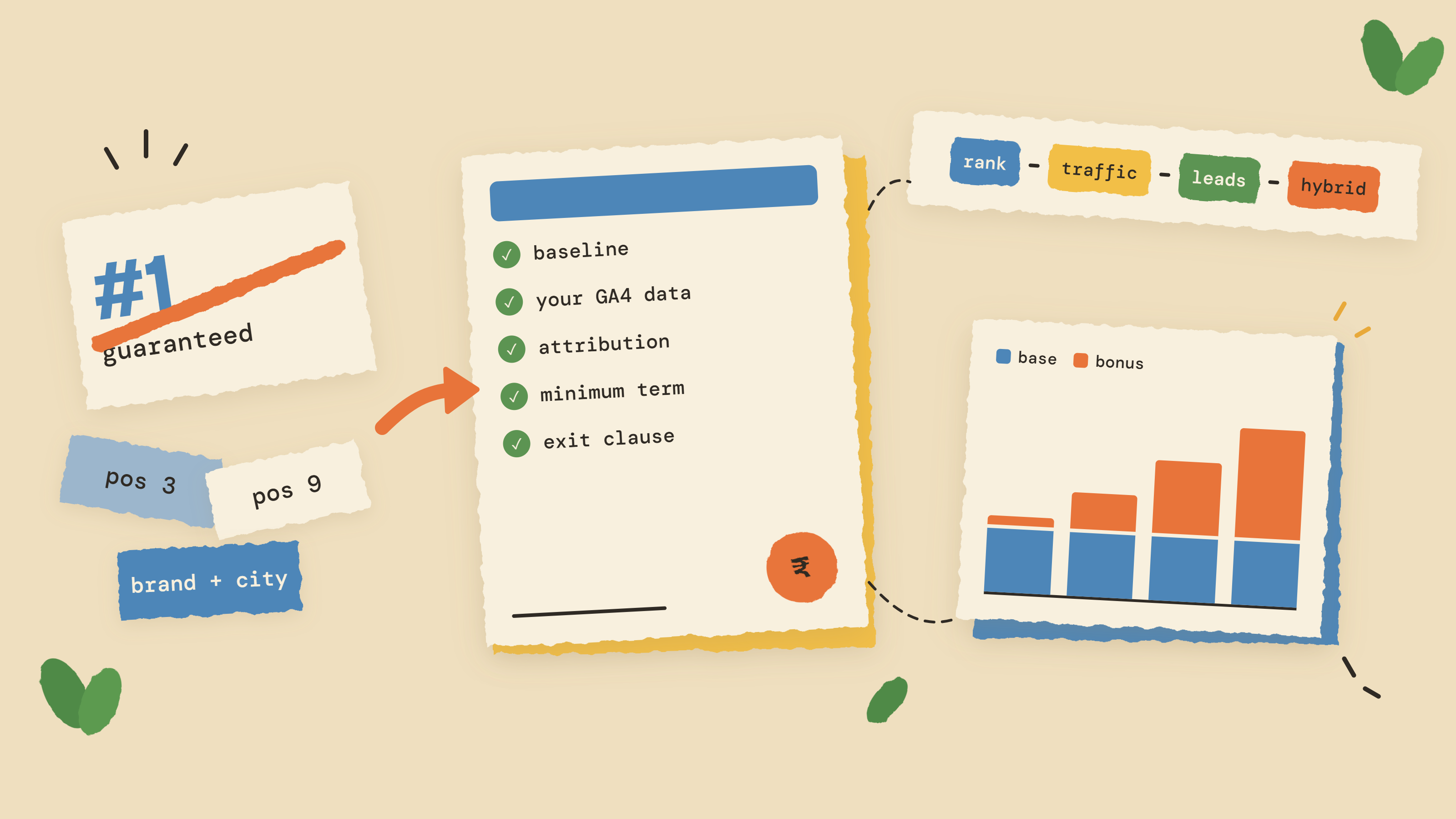
| What will you report? | Demos, trials, RFQs and pipeline from organic | Only rankings and traffic |
| Can you work with our developers? | Understands rendering, routing and deployments | Wants a plugin to "fix SEO" |
| How is content written? | Writers interview your team and use the product | Bulk AI articles on a fixed count |
| Can you guarantee page one? | No, and explains why | Yes, with a guarantee |
| Show relevant work | Case studies with real numbers and links | Vague logos, no data |
A specialist SaaS SEO agency pays off once you have product-market fit, a sales process and budget for six to twelve months of work. If you are comparing Indian and overseas options, our buyer's guide to outsourcing SEO to India covers pricing models and contracts.
Typical engagement scope
A B2B SEO service should cover a technical audit, a funnel keyword map, a content plan tied to sales, on-page fixes, link earning and monthly lead reporting. Our SEO plans start at ₹15,000 a month for on-page and technical SEO with 10 tracked keywords (see pricing); most SaaS and industrial sites need more content than that floor includes.
What building our own products taught us
Running our own software, every product page has to explain itself to a stranger, answer the finance and IT questions, and earn a demo with no salesperson in the room. The lessons: plan URLs and rendering before code, build bottom-funnel pages before blog posts, write from customer conversations, and measure leads, not visits.
If you are building a SaaS product or need your web app to be found, start with our web app development team, or get a free AI and SEO audit of your current site from our SEO service page.
Frequently asked questions
What does a SaaS SEO agency do differently from a regular SEO agency?
It plans content around a long buying cycle with several decision makers, prioritises comparison, integration and use-case pages, and works closely with developers on rendering and routing in JavaScript apps. It also reports on trials, demos and pipeline rather than just traffic and rankings.
How is SEO for manufacturers different?
SEO for manufacturing companies depends on detailed catalogue pages with HTML spec tables, standards, applications and RFQ forms, written in the exact terms buyers search. Large catalogues also need careful handling of filter URLs so Google does not waste crawling on near-duplicates.
What is app optimisation?
App optimisation, or app store optimisation (ASO), improves how an app ranks and converts in the Apple App Store and Google Play. It covers the title, subtitle or short description, keywords, screenshots, and ratings and reviews, which Apple says can influence ranking.
Is SEO worth it for an early-stage startup?
Yes, if you start with the basics: a server-rendered site, a few strong solution and comparison pages, and content written from real customer conversations. A full agency retainer usually makes more sense once you have product-market fit and a working sales process.
Should a manufacturer rely on IndiaMART or build its own website?
Most should do both. Marketplaces bring quick enquiries but list competitors beside you and often share leads, while your own website builds exclusive, higher-value leads and export enquiries over time.
What should content writing for SaaS include?
Good SaaS content writing is based on sales and support conversations, shows the real product with screenshots, speaks to one stakeholder at a time and links naturally to feature, integration and comparison pages. Generic articles that could describe any product rarely rank or convert.
Shubham N Datarkar
Founder, Timewheel
Shubham founds and leads Timewheel, a Nagpur product studio that builds its own software and runs SEO, AI-search and growth for businesses across India. He writes from hands-on work shipping products and measuring what actually moves rankings and revenue.
Comments
Be the first to comment.