Pay for performance SEO is a pricing model where you pay an agency only when an agreed result shows up, such as a keyword reaching page one, organic traffic crossing a target, or a qualified lead arriving. It sounds risk free, but the result you pay for shapes the work you get. Done carelessly it rewards easy vanity keywords and risky shortcuts; done with a fair contract it can work for a narrow set of businesses.
What pay for performance SEO actually means
In a standard SEO retainer you pay a fixed monthly fee for a defined scope of work. You carry the risk that the work does not move the numbers.
SEO pay for performance flips part of that risk. The agency agrees to be paid against a metric instead of (or on top of) its hours. If the metric does not move, the agency earns little or nothing. If it moves a lot, the agency can earn far more than a retainer would pay.
Performance pricing is not a discount. Agencies price in the risk, so per-result fees are usually set high enough to cover the clients where nothing happened. You are buying a different risk profile, not cheaper SEO.
The five pay per performance SEO models compared
Almost every offer is a version of one of these five. The labels vary (pay on results, pay per performance SEO, performance based SEO), so read the contract, not the brochure.
| Model | You pay when | Pros | Cons |
|---|---|---|---|
| Pay per ranking (keyword position) | A tracked keyword reaches a set position, for example top 10 or top 3, often billed per keyword per month | Easy to understand; easy to verify with a rank tracker | Rewards low-competition keywords; rankings vary by location and device; ranking is not revenue |
| Pay per traffic | Organic sessions or clicks pass a baseline, billed per extra visit or in tiers | Closer to business value than rankings; measurable in Search Console and GA4 | Traffic can come from irrelevant queries; seasonality and Google updates move numbers either way |
| Pay per lead | A qualified enquiry (form, call, WhatsApp click) arrives from organic search | Ties fees to something sales can use | Needs clean tracking and a shared definition of "qualified"; arguments over attribution are common |
| Revenue share | The agency takes a percentage of revenue attributed to organic search | Strongest alignment with your bottom line | Requires sharing sales data; attribution disputes; can become very expensive once SEO compounds |
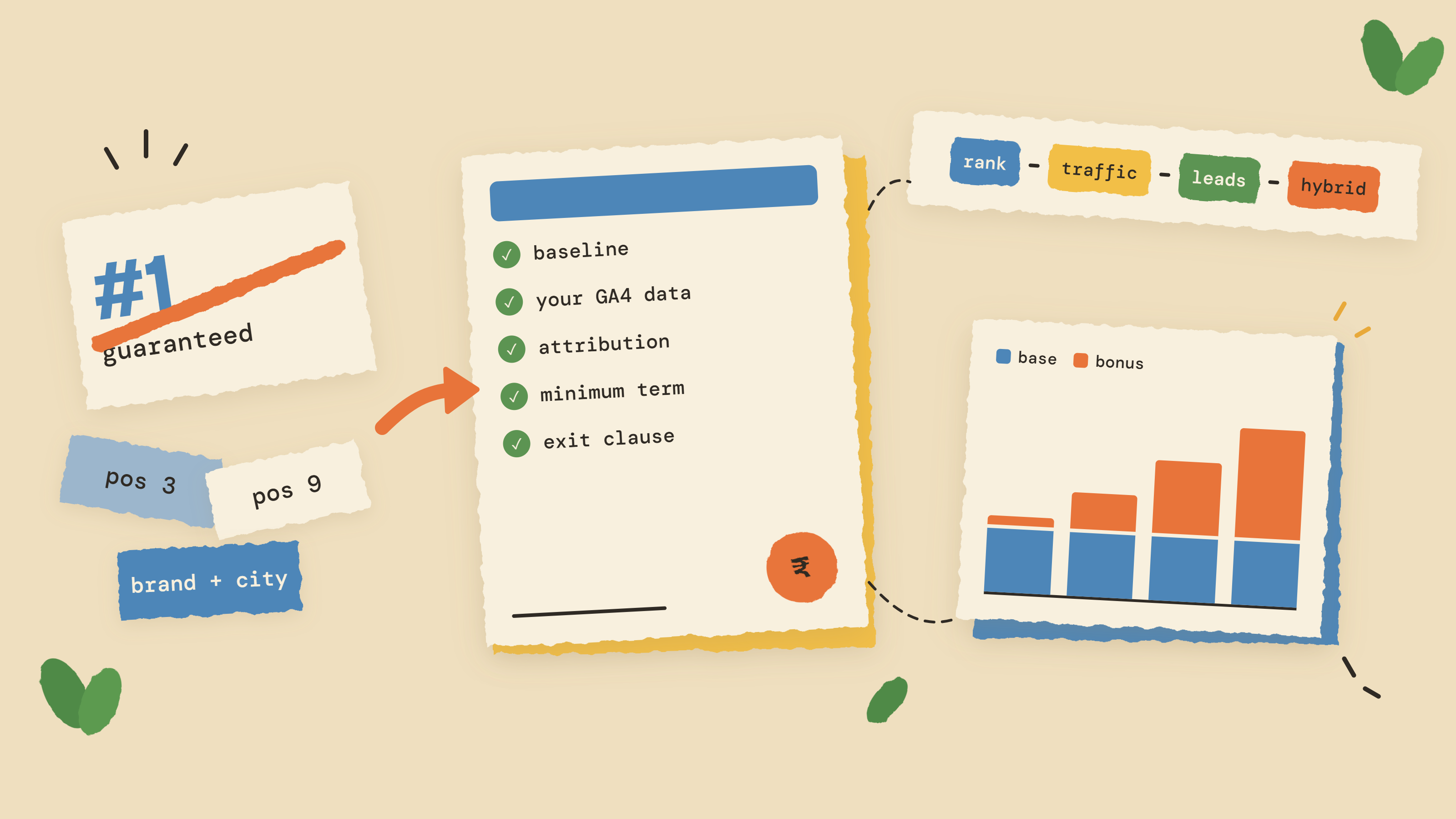
| Hybrid retainer plus bonus | A smaller fixed fee every month, plus a bonus when agreed targets are hit | Agency can still do slow foundational work; both sides share risk | Slightly more complex to write; targets still need careful choice |
A quick worked example
Here is an illustrative comparison, not a real quote. Suppose a Pune interior design studio is offered three deals for six months:
- Retainer: ₹20,000 a month, fixed. Six months costs ₹1,20,000 whatever happens.
- Pay per ranking: ₹3,000 per keyword per month in the top 5, across 15 keywords. If ten keywords sit in the top 5 by month three, the bill is ₹30,000 a month from then on, even if those keywords bring three enquiries a month.
- Hybrid: ₹12,000 a month base, plus ₹1,500 for every qualified organic lead above a baseline of 8 a month. If leads rise to 20 a month, the bill is ₹30,000, but you are paying for 12 extra leads you can see in your CRM.
The two non-retainer bills can end up at the same number. The difference is what you received for it.
Why ranking-based pricing pushes agencies toward vanity keywords
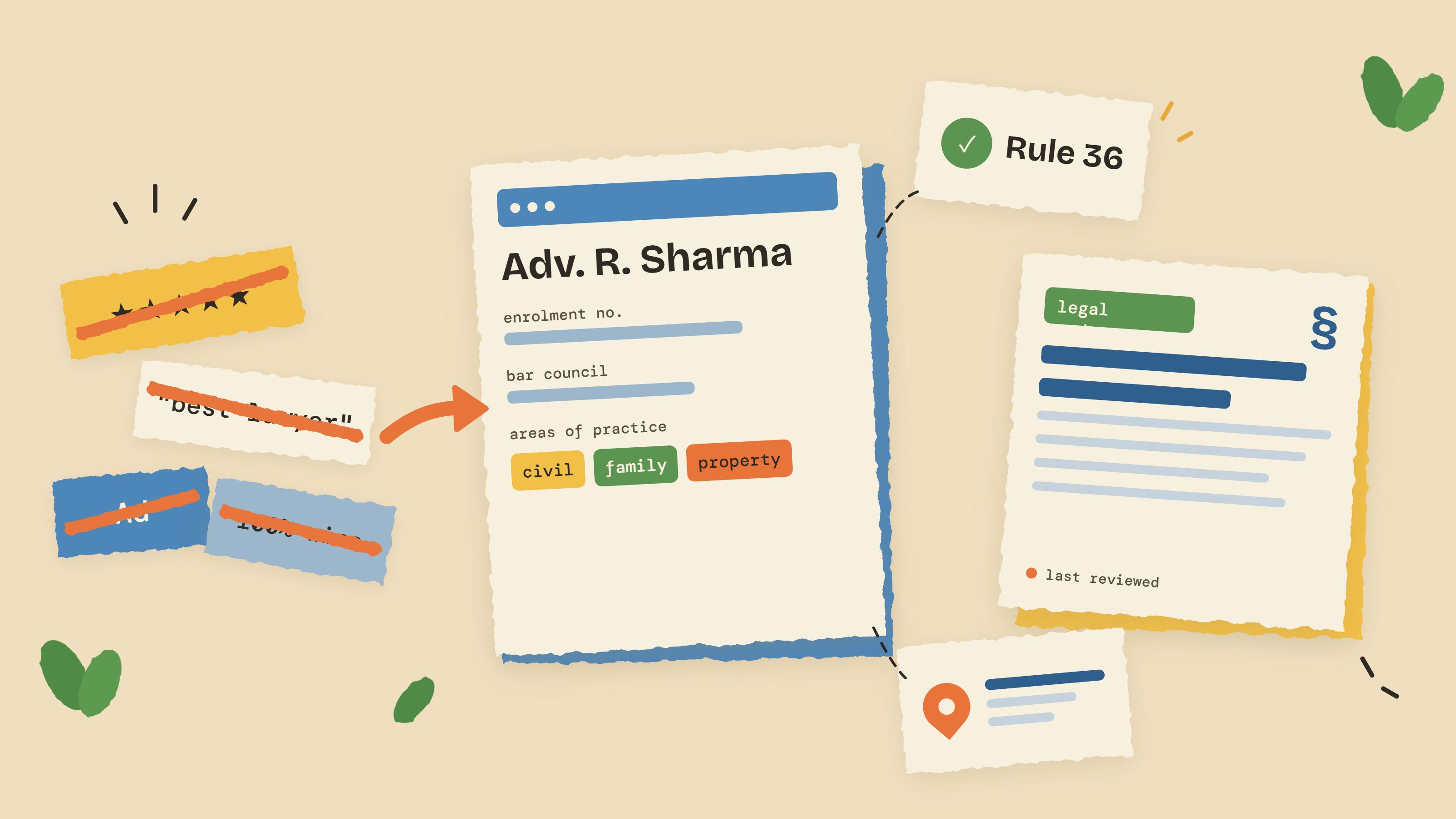
If an agency is paid per keyword in the top 10, the rational move is to pick keywords that are easy to rank for. Nothing in the contract says the keywords must bring customers, so the list fills up with phrases like your brand name plus city, very long variations nobody types, or terms with almost no search demand.
- Branded terms: "sharma dental clinic nagpur" will usually rank for the clinic's own site with very little work. Charging for it is charging for something you already had.
- Ultra long-tail phrases: "best affordable modular kitchen designer near wardha road for 2bhk" might reach position 1 quickly because nobody competes for it, and almost nobody searches it.
The fix is to agree the keyword list together before the contract starts and to require evidence of demand for each term. Our guide to keyword research and free tools shows how to check intent and volume yourself, so you are not relying on the agency's list.
Rankings are not one number
Even an honest ranking report is slippery. Google's own explanation of how Search works says relevance depends on hundreds of factors, which could include the user's location, language and device. A keyword can show position 3 for someone in Dharampeth on a phone and position 9 for someone in Andheri on a laptop. If the agency's rank tracker checks from a single location, the number you are billed on may not match what your customers see.
That is why any performance deal should use your own Google Search Console data, not a tracker the agency controls.
The black hat risk in pay for performance search engine optimization
When income depends on hitting a ranking fast, the temptation to cut corners grows. The quickest ways to push a page up are usually the ones Google prohibits, such as buying links or spinning out thin pages.
Google's spam policies list buying or selling links for ranking purposes, excessive link exchanges, automated link building and low-quality directory links as link spam. The same page states plainly that sites violating these policies may rank lower in results or not appear in results at all, and violations can lead to a manual action.
The uncomfortable part is who carries that risk. The agency's invoice is paid when the ranking appears. If a penalty arrives months later, it lands on your domain, and the agency may already have moved on. We covered this pattern in detail in white hat vs black hat SEO and why guarantees backfire, and the link side of it in dofollow vs nofollow backlinks.
Two contract lines reduce this risk: a written ban on paid links, private blog networks and automated link building, and a requirement that the agency shares a list of every link it builds, with the right to ask for removal.
What Google says about guaranteed rankings
Many pay for performance SEO pitches lean on the word "guaranteed". Google addresses this directly. Its page on whether you need an SEO says that no one can guarantee a #1 ranking on Google, and advises that if an SEO guarantees first place in search results, you should find someone else.
The same page warns against claims of a special relationship with Google, offers of a "priority submit", and agencies that are secretive about their methods. Google also says it does not accept payment to rank a site higher.
So a performance contract is not a guarantee. It is a promise to waive or reduce fees if results do not appear. That can be a fair deal, but treat any sales pitch that blurs the two as a red flag.
How to structure a fair performance clause
If you do want SEO pay for performance, the contract decides whether it helps you or just changes how the invoice looks. These five elements make the biggest difference.
1. A written baseline
Before work begins, export the last three to six months of clicks, impressions, average position per agreed keyword, organic sessions and organic leads, and attach it to the contract. Without a baseline, an agency can be paid for traffic you already had, or for a seasonal rise that would have happened anyway (think Diwali for a gifting store, or admissions season for a coaching institute).
2. Metrics from your own accounts
Bill against data from your own Google Search Console and Google Analytics 4 properties, with the agency given user access, not ownership. The Search Console Performance report shows clicks, impressions, CTR and average position from Google Search, and lets you filter by query, page, country and device. That gives both sides one shared source of truth for search visibility.
For leads and revenue, use GA4 key events (form submissions, calls, WhatsApp clicks, purchases) that you set up and can audit. If you are unsure your site is even indexed properly, sort that first with our checklist on why a site is not showing on Google.
3. Clear attribution rules
For pay per lead or revenue share deals, agree in writing which conversions count as "organic". GA4's attribution documentation describes the models currently available: data-driven attribution, paid and organic last click, and Google paid channels last click. Last-click models give all the credit to one channel, while data-driven attribution spreads credit across the path based on your own conversion data.
Pick one model, write it into the contract, and do not change it mid-term. Also decide how to handle branded searches. If someone sees your Instagram ad, then Googles your brand name and fills a form, many reports will call that organic. Most fair contracts either exclude branded queries from the bonus or pay a lower rate for them.
4. A minimum term
The first months of SEO often go into technical fixes and content that do not pay off immediately. A minimum term of around six months gives the agency room to do that work and gives you enough data to judge the trend.
5. An exit clause and ownership terms
Make sure you can leave after the minimum term with 30 days' notice and keep everything: content, pages, account access and links built in your name. Add a line that any breach of Google's spam policies by the agency allows immediate termination.
When pay on performance SEO can make sense
Performance pricing is not always a bad idea. It tends to work when these conditions are true:
- Your site is technically sound already. If the foundations are broken, the first months are pure fixing, and no sensible agency will do that on spec.
- Each lead or sale is worth a lot. A builder, a hospital, a B2B manufacturer or a law practice can afford a meaningful per-lead bonus because one customer is worth lakhs.
- You can track conversions cleanly. Forms, call tracking and a CRM, so both sides can see what came from organic search.
- The keyword set is small and commercial. A local service business with ten clear money keywords ("physiotherapist in Nagpur", "AC repair Manish Nagar") is easier to measure fairly than a content site with thousands of queries.
- You choose the hybrid model. A base fee for the work plus a bonus for outcomes beats pure pay per ranking in almost every case.
It tends to fail for brand-new websites, very competitive national keywords and businesses that will not share conversion data.
Pay for performance SEO vs a standard retainer
A fixed retainer pays for a defined scope of work. The risk sits with you, but so does the control: you can see the tasks and judge the quality of content and links. You also do not pay more just because SEO starts compounding in month ten.
For context, our own SEO plan starts at ₹15,000 a month and covers on-page and technical SEO, 10 tracked keywords, monthly content optimisation, and rank and traffic reporting. The full breakdown of what each service includes is on our pricing page. If you are comparing packages from several agencies, our guide to SEO packages for small business in India shows what you should get at each price level.
A good retainer still reports against outcomes. Ask for monthly numbers from your own Search Console and GA4, compared against the starting baseline, the same way a performance contract would. Our Everything Powerlifting case study, where organic traffic grew from 292 to 889 visits a month and organic keywords from 100 to 887, and the Occasion Cakes local SEO case study show the kind of before-and-after reporting you should expect from any agency, whatever the pricing model.
Questions to ask before you sign a performance SEO deal
Use these whether the offer is pure performance, hybrid or retainer.
- Which exact metric triggers payment, and from which tool is it measured?
- Who chooses the keywords, and what search demand does each one have?
- Are branded searches included in the performance fee?
- What is the baseline, and is it written into the contract?
- Which attribution model will we use for leads or revenue?
- What link building tactics will you use, and will you share a list of every link?
- What happens to content and links if I leave?
- What is the minimum term and the notice period?
- Can you show past results with the client's permission, and what timeframe did they take?
For more on vetting agencies generally, see how to choose an SEO company in Mumbai and other Indian cities.
The bottom line
Pay for performance SEO is a way of sharing risk, not removing it. Pure pay per ranking deals reward the wrong keywords and invite shortcuts that can hurt your domain. A hybrid deal with a baseline, metrics from your own accounts, clear attribution, a minimum term and a clean exit can be fair to both sides. Whatever you choose, never accept a guarantee, and always keep ownership of your data.
If you would like a second opinion on a performance SEO offer you have received, or want to compare it with a standard plan, start with the free AI and SEO audit on our SEO services page, check the starting prices on our pricing page, or book a short call.
Frequently asked questions
What is pay for performance SEO?
It is a pricing model where an SEO agency is paid only when an agreed result is achieved, such as a keyword reaching a set position, organic traffic passing a target, qualified leads arriving, or a share of organic revenue. Many deals combine a smaller fixed fee with a performance bonus.
Is pay on performance SEO worth it?
It can be, for businesses with a technically sound site, high-value leads and clean conversion tracking, especially on a hybrid retainer plus bonus model. Pure pay per ranking deals are usually poor value because they reward easy keywords that bring few customers and can encourage risky link building.
Can an SEO agency guarantee first page rankings?
No. Google's own guidance says no one can guarantee a #1 ranking on Google and advises finding someone else if an SEO promises first place. A performance contract only promises that fees are reduced or waived if results do not appear; it is not a guarantee.
How much does pay per performance SEO cost in India?
There is no standard rate. Fees are set per keyword, per lead, per extra visit or as a revenue percentage, and agencies price in the risk of clients where nothing happens. Compare the likely total over six to twelve months with a fixed retainer, such as SEO plans starting around ₹15,000 a month, before deciding.
What metrics should a performance SEO contract use?
Use data from your own Google Search Console (clicks, impressions, average position) and GA4 key events such as forms, calls and purchases from organic search. Agree a written baseline, one attribution model, and whether branded searches count, before work begins.
Shubham N Datarkar
Founder, Timewheel
Shubham founds and leads Timewheel, a Nagpur product studio that builds its own software and runs SEO, AI-search and growth for businesses across India. He writes from hands-on work shipping products and measuring what actually moves rankings and revenue.
Comments
Be the first to comment.