The difference between dofollow and nofollow links is whether the linking site vouches for your page. A normal link (people call it "dofollow") can pass ranking credit to the page it points to, while a link marked rel="nofollow", rel="sponsored" or rel="ugc" tells Google not to count it as an endorsement, although Google now treats those labels as hints rather than strict rules. Both kinds are normal in a healthy backlink profile, and the quality of the site linking to you matters far more than the attribute.
What is a backlink, and why does it still matter?
A backlink is a link from another website to yours. If a Nagpur food blogger links to your restaurant's menu page, that is a backlink for you and an outbound link for them. Search engines use links in two ways: to discover new pages, and as one signal of which pages other people find worth citing.
Backlinks are part of off-page SEO, the work that happens away from your own site. If you are still fixing titles, speed and content, start with our on-page vs off-page SEO checklist, because links pointing at a weak page rarely rescue it. And if your site is not appearing on Google at all, links are usually not the first problem: check the common reasons a site is not showing on Google first.
Dofollow and nofollow links: the real difference
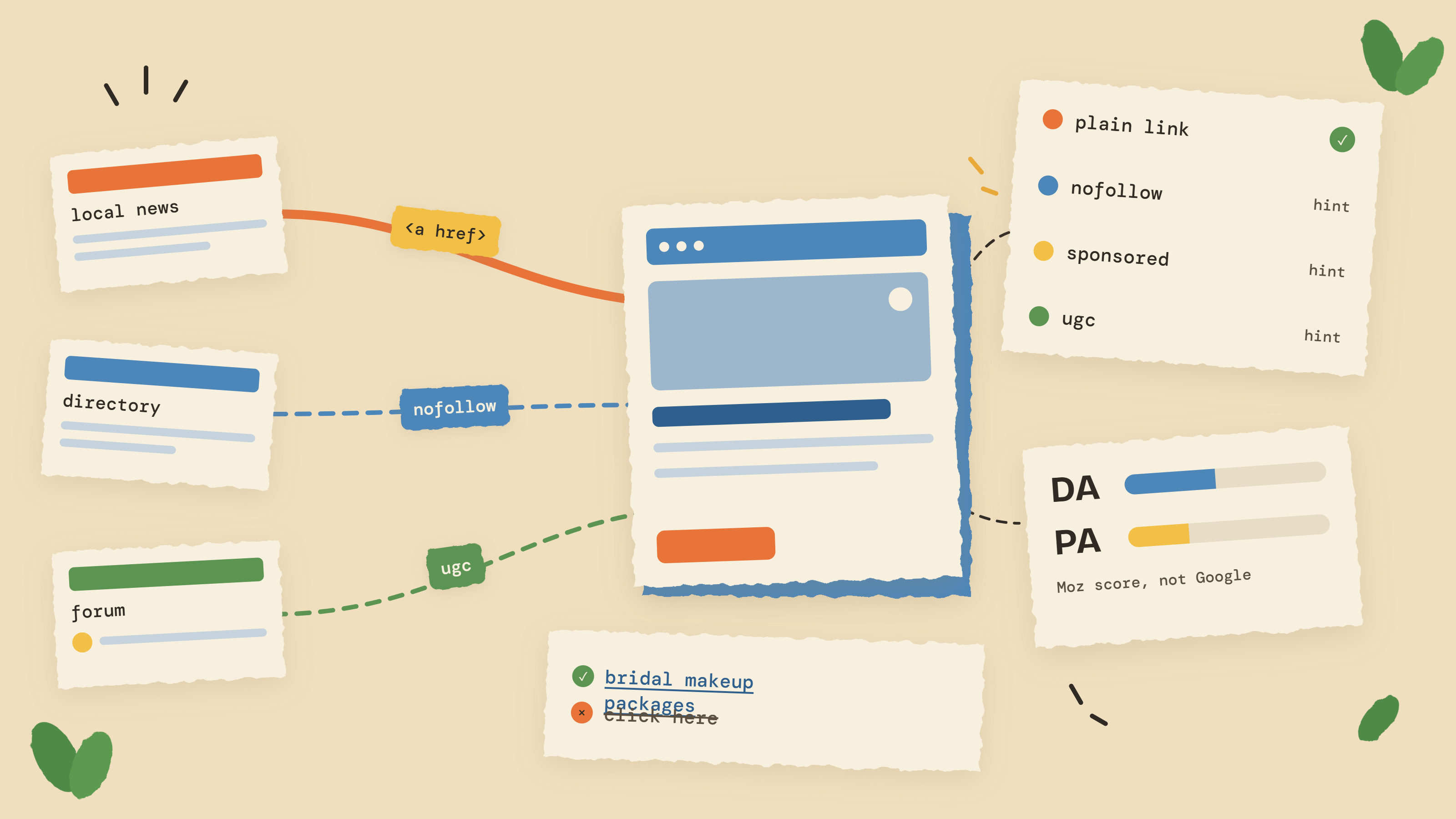
Here is the part most guides get slightly wrong: there is no rel="dofollow" attribute. "Dofollow" is just shorthand for a plain link with no qualifying attribute. A nofollow link is the same HTML link with a rel value added, for example rel="nofollow".
Google's guide to qualifying outbound links lists three values site owners can use, and you can combine them, such as rel="ugc nofollow":
rel="sponsored": for ads, paid placements and any link you were paid or compensated for. Google prefers this over nofollow for paid links.rel="ugc": for user-generated content such as blog comments, forum posts and reviews. Sites may remove it for trusted, long-standing contributors.rel="nofollow": for when no other value fits and you do not want your site associated with, or crawling, the linked page.
Nofollow is a hint, not a wall
When Google introduced sponsored and ugc in 2019, it announced in its post on evolving nofollow that all three attributes would work as hints for ranking, and that nofollow would also become a hint for crawling and indexing from March 1, 2020. Existing nofollow links did not need to be changed.
In practice this means Google may still choose to discover or weigh a nofollow link, but you should never assume one will help your rankings. Treat nofollow links as traffic and visibility, not as ranking fuel.
Quick comparison table
| Link type | HTML | Typical use | Passes ranking credit? |
|---|---|---|---|
| Plain ("dofollow") | <a href="..."> | Editorial citations, natural mentions | Can, if Google trusts it |
| Nofollow | rel="nofollow" | Untrusted or unvouched links | Treated as a hint, usually not |
| Sponsored | rel="sponsored" | Paid posts, ads, affiliate links | Treated as a hint, usually not |
| UGC | rel="ugc" | Comments, forums, Q&A answers | Treated as a hint, usually not |
A mix of both types is normal. A profile made only of plain links from unknown sites looks less natural than a mixed one.
What is anchor text, and how should it look?
Anchor text is the clickable words of a link. In "see our bridal makeup packages", the italic words are the anchor. Google reads anchor text, and the words around it, to understand what the linked page is about.
Google's link best practices say good anchor text is descriptive, reasonably concise and relevant to both pages. A useful test from that guide: read the anchor on its own, out of context, and see whether it still tells you where the link goes.
Anchor text do's and don'ts
- Do describe the destination: "GST invoice format for freelancers" beats "this page".
- Do keep it short and link only the key phrase, not a whole sentence.
- Don't use generic anchors like "click here", "read more" or "website" for important links.
- Don't force keywords in. Google's own guide warns that if an anchor feels forced, it probably is, and keyword stuffing breaks its spam policies.
- Don't chain several links next to each other; each one loses its context.
Natural backlink anchors are messy: your brand name, your URL, "Timewheel's guide", a topic phrase. If 60 sites all link to you with the exact anchor "best SEO company in Pune", that uniformity is a footprint of paid or arranged links, not of genuine recommendations.
What is a backlink profile, and how do you review yours?
Your backlink profile is the full set of links pointing to your site: which domains link, which of your pages they point to, the anchor text they use and how that changes over time. A healthy profile for a small Indian business usually shows a modest number of relevant domains (local media, directories, suppliers, associations, happy customers) rather than hundreds of unrelated blogs.
Use the Search Console Links report (free)
The most trustworthy place to start is Google's own data. The Search Console Links report shows:
- Top linked pages: which of your pages earn the most external links.
- Top linking sites: the domains linking to you, grouped by root domain.
- Top linking text: the anchor text other sites use for you.
- Internal links: how your own pages link to each other.
Keep its limits in mind: the report is a sample rather than a complete list, tables show up to 1,000 rows, it can include links that were removed, and it does not tell you whether a link is nofollow.
A 20-minute review routine
- Export "Top linking sites" and sort into three buckets: relevant (your industry or city), neutral (big platforms, directories) and junk (scraper sites, foreign gambling or pharma pages).
- Check "Top linking text". Mostly brand and URL anchors is normal. Lots of exact-match money keywords suggests someone bought links in the past.
- Open "Top linked pages". If only your home page earns links, plan content worth citing for service pages and guides.
- Repeat every quarter and note new domains, so you can spot sudden spikes.
Random spammy links pointing at you are common; do not panic over each one. Third-party tools like Ahrefs, Semrush or Moz show bigger link indexes and extra metrics, which brings us to DA and PA.
What is domain authority and page authority?
Domain Authority (DA) and Page Authority (PA) are scores created by Moz, an SEO software company. They are not Google metrics, and Google does not use them. Ahrefs (Domain Rating) and Semrush (Authority Score) sell similar scores built on their own data.
- Domain Authority: Moz describes it as a score of how likely a whole website is to rank, calculated by a machine learning model that relies mainly on backlink data from its Link Explorer index. Moz's own Domain Authority guide states plainly that DA is not a Google ranking factor and has no effect on the search results.
- Page Authority: the same idea at the level of a single URL. Moz's Page Authority page says it runs from 1 to 100 on a logarithmic scale and predicts how well a specific page might rank.
What is DA and PA in SEO used for?
Both scores are best used comparatively, which Moz itself recommends. There is no universal "good" DA. A DA of 25 can be strong for a Nagpur dental clinic if competing clinics sit at 10 to 15, and weak for a national ecommerce brand.
Because the scale is logarithmic, moving from 20 to 30 is much easier than moving from 60 to 70. And because the score depends on Moz's crawl, it can rise or fall when Moz updates its index, even if nothing changed on your site.
How to use DA and PA sensibly
- Compare your site with the sites actually ranking for your keywords, not with Wikipedia or Amazon.
- Use it as a quick filter when shortlisting outreach targets, then check the site by hand.
- Never pay for a link because of a DA number. DA can be inflated with spam links, and a high-DA site that sells posts to anyone is exactly what Google's spam team looks for.
- Report business outcomes (leads, calls, orders) to your team, not DA. For example, our Occasion Cakes case study tracks orders and calls, which is what matters to the owner.
How to get backlinks legitimately
Google's spam policies make the rule simple: links you earn because people genuinely want to cite you are fine; links you buy, trade or manufacture to influence rankings are not.
1. Digital PR and local news
Journalists need data, stories and expert quotes. Share something only you can: a survey of 200 customers, pricing trends in your trade, a city-specific guide. Local newspapers' websites, city portals and trade magazines often link to sources.
2. Linkable resources
Create pages people bookmark and reference: a cost calculator, a checklist, a glossary, an honest comparison. A CA firm's "GST due dates 2026" page or a wedding planner's "Nagpur venue capacity list" can earn links for years. Our guide on writing content people actually read helps here, and if you need help producing it, see what content development services include.
3. Local citations and listings
For local businesses, consistent listings on Google Business Profile, Bing Places, Justdial, IndiaMART, Sulekha and industry associations are the foundation. Many of these links are nofollow, but they confirm your name, address and phone number across the web. Our guide to search engine listing on Google, Bing and Indian directories walks through it.
4. Relationships you already have
Suppliers, brands you stock, event organisers, colleges you recruit from and clients you built something for often have "partners" or "stockists" pages. Ask. These links are relevant by nature, which is exactly why they are valuable. Just avoid "you link to me, I link to you" swaps at scale: Google lists excessive link exchanges and cross-linking partner pages as link spam.
Guest posting: "SEO write for us" pages and guest blogging websites
Search "seo write for us" or "technology write for us" and you will find thousands of pages inviting guest articles. Some belong to real publications with editors. Many belong to sites that exist mainly to sell links. The format is not the problem; the intent is.
What Google accepts and what it calls link spam
Google's spam policies on link spam list, among other things: buying or selling links for ranking (including payment in goods, services or free products), excessive link exchanges, automated link building, and paid advertorials or guest posts that include ranking-passing links or optimised anchor text. The same policy says paid links are fine when they carry rel="sponsored" or rel="nofollow".
| Usually acceptable | Link scheme territory |
|---|---|
| Writing a genuinely useful article for a respected industry site, with a bio link | Paying per post on a site that publishes anyone who pays |
| A paid or sponsored post where the link is marked sponsored or nofollow | A paid post with a plain link and an exact-match keyword anchor |
| Links that point to the source you actually reference | Spinning one article into 50 versions for 50 "guest blogging websites" |
| Contributing to a publication your customers read | Guest posting on unrelated sites purely because their DA looks high |
The honest test: would you still write the article if the link were nofollow? If yes, because the audience is valuable, it is probably a good opportunity.
How to vet guest posting submission sites and backlink sites lists
Downloadable "backlink sites lists" and "1,000 guest posting submission sites" spreadsheets are popular in India. Most are recycled lists of old directories, bookmarking sites and link farms, the exact categories Google names as low-quality. Use this checklist before you pitch or pay anyone.
Vetting checklist
- Relevance: does the site cover your industry or city, and would your customers read it?
- Real traffic: does it rank for anything meaningful? A quick check in any SEO tool or a
site:search shows whether Google indexes and values it. - Editorial standards: are there named authors, edits, rejections? Or does every post look like it was written for a link?
- Outbound link pattern: open five recent posts. If each links to casinos, CBD, loan apps and essay services, walk away.
- Disclosure: if money changes hands, will they mark the link sponsored? A reputable site will.
Red flags
- A "write for us" page that lists prices, DA and "dofollow guaranteed" up front.
- Categories that cover everything from health to crypto to home decor.
- Offers of "500 high-DA backlinks for ₹999" or guaranteed ranking jumps.
- Requests to use a specific keyword-rich anchor in every article.
- Private blog networks pitched as "our partner sites".
If an agency sells you link packages like these, read why black hat SEO services and guarantees backfire before signing. And when comparing agencies, our breakdown of SEO packages for small businesses shows what honest link building looks like inside a monthly plan.
Putting it together
Do not chase a dofollow count or a DA target. Make pages worth citing, get listed accurately, build relationships with people in your industry, and label paid links honestly. Review the Search Console Links report each quarter to see what is working.
If you would rather have an expert handle it, our SEO service in Nagpur starts at ₹15,000 a month (all plans on the pricing page), and you can request a free AI and SEO audit from the same page to see where your backlink profile and on-page SEO stand today.
Frequently asked questions
What is the difference between dofollow and nofollow links?
A dofollow link is a normal link with no rel qualifier, so it can pass ranking credit if Google trusts it. A nofollow link carries rel="nofollow", which asks Google not to treat it as an endorsement. Since 2020 Google treats nofollow as a hint, so it may still be crawled, but you should not count on it for rankings.
What is anchor text in SEO?
Anchor text is the clickable text of a link. Google uses it, along with the surrounding words, to understand the linked page. Good anchor text is short, descriptive and natural; generic anchors like 'click here' and forced keyword anchors are both poor choices.
What is DA and PA in SEO?
DA (Domain Authority) and PA (Page Authority) are 1 to 100 scores made by Moz that estimate how likely a whole site or a single page is to rank, based mostly on backlink data. They are not used by Google. Use them to compare your site with competitors in the same search results, not as a goal on their own.
What is a backlink profile?
A backlink profile is the full set of links pointing to your site: the linking domains, the pages they link to, the anchor text and how it changes over time. You can review a sample of yours for free in the Links report in Google Search Console.
Are guest posting submission sites safe for SEO?
Some are, many are not. Writing for a real, relevant publication with editors is fine. Paying for posts with plain, keyword-rich links, or using mass lists of guest blogging websites that publish anything, falls under Google's link spam policy. Check relevance, real traffic, outbound links and whether paid links are marked sponsored.
Do nofollow backlinks help SEO?
Not directly for rankings in most cases, but they still have value. A nofollow link from a popular site can send visitors, leads and brand searches, and those visitors may later link to you normally. A natural profile includes a mix of both types.
Shubham N Datarkar
Founder, Timewheel
Shubham founds and leads Timewheel, a Nagpur product studio that builds its own software and runs SEO, AI-search and growth for businesses across India. He writes from hands-on work shipping products and measuring what actually moves rankings and revenue.
Comments
Be the first to comment.