Blogging for lawyers in India works when it educates, not when it advertises. Bar Council of India rules stop advocates from soliciting work or advertising, but they leave room for a website with basic professional details and for genuinely informative writing about the law. Done carefully, blogging for lawyers builds search visibility and trust without crossing the line into solicitation.
This is not legal advice. It is a marketing guide written by a web and SEO studio. For any doubt about your own conduct, check the current Bar Council of India Rules and ask your State Bar Council.
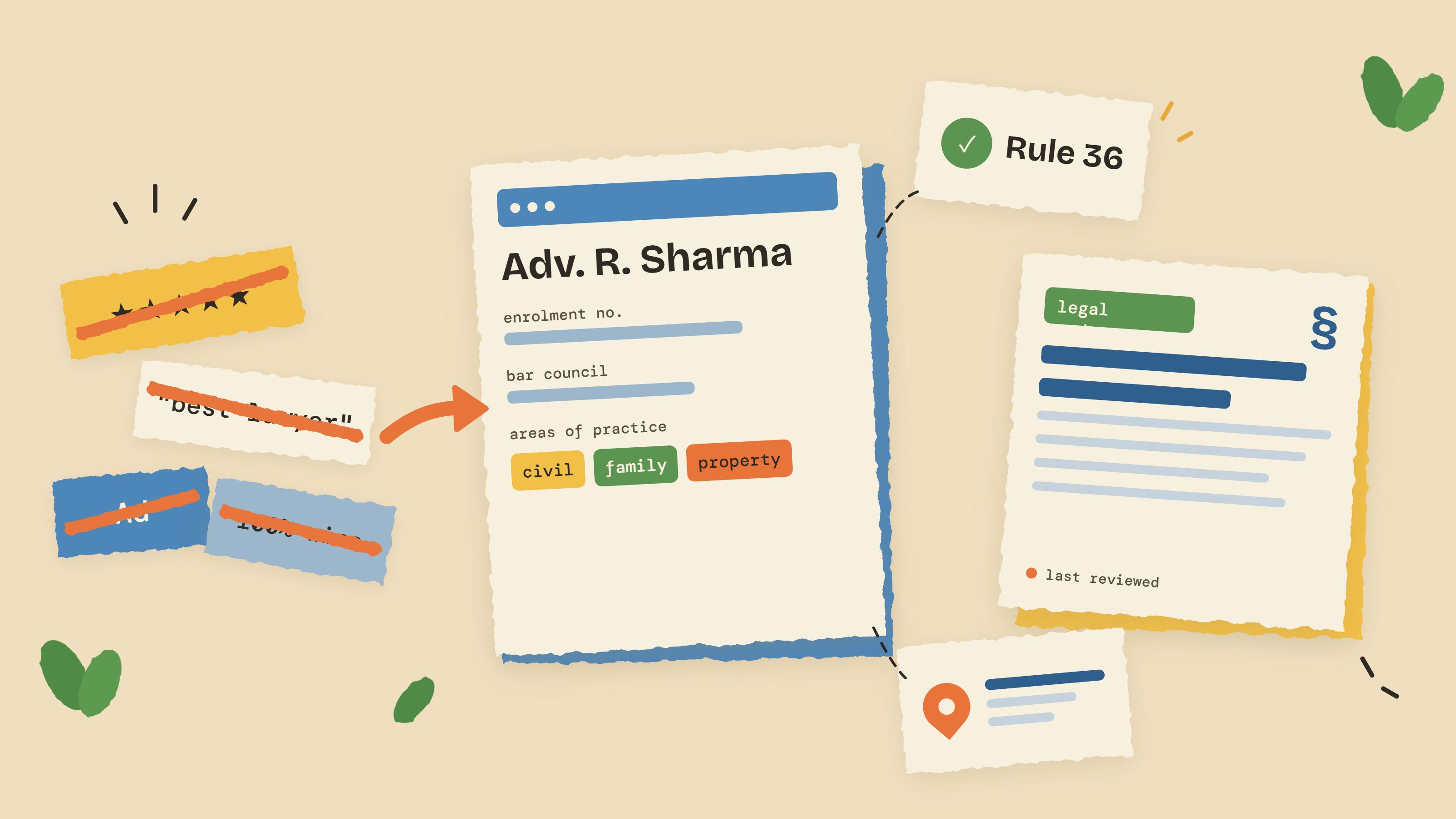
What Rule 36 Says, and the 2008 Website Exception
The Bar Council of India Rules, Part VI, Chapter II (Standards of Professional Conduct and Etiquette) contain Rule 36. As quoted in an SCC Times expert column on digital solicitation, the rule says an advocate shall not solicit work or advertise, either directly or indirectly. It names the usual channels: circulars, advertisements, touts, personal communications, interviews not warranted by personal relations, inspired newspaper comments and photographs published in connection with cases.
The same rule says sign boards, name plates and stationery must be of reasonable size and must not claim a specialisation, a Bar Council post, or a past role as Judge or Advocate General.
The 2008 proviso for websites
In 2008, while the Supreme Court was hearing a challenge to Rule 36 filed by advocate V.B. Joshi, the Bar Council of India added a proviso. As recorded in the ITATOnline summary of the amendment and press reports, the rule now "will not stand in the way of advocates furnishing website information as prescribed in the Schedule". Any input beyond the particulars the BCI approved is deemed a violation of Rule 36 and can lead to misconduct proceedings under Section 35 of the Advocates Act, 1961. SCC Times cites the proviso as BCI Resolution No. 50/2008.
Press reports of the Schedule describe the permitted particulars as:
- Name, address, telephone numbers and email ID
- Enrolment number and date of enrolment
- The State Bar Council where you were originally enrolled and where you are currently on the roll
- The Bar Association you belong to
- Professional and academic qualifications
- Areas of practice
Why this matters in 2026
Enforcement is real. In July 2024, after the Madras High Court's decision in P.N. Vignesh v. Bar Council of India, the BCI sent cease and desist notices to Quikr, Sulekha, Just Dial and Grotal, and told State Bar Councils to act against advocates soliciting work through online portals, as reported in SCC Times coverage of the BCI press release. The Madras judgment had flagged listings labelling advocates "top advocate" or "premium". The real question is how to stay findable and credible within the rules.
What Advocates Can and Cannot Do Online: A Quick Table
A practical reading of the rule and the cases above. When in doubt, leave it out.
| Activity | Generally safe? | Why |
|---|---|---|
| Website with name, contact, enrolment, Bar Council, qualifications, areas of practice | Yes | These are the particulars in the 2008 Schedule |
| Articles explaining laws, procedures and new judgments in neutral terms | Usually yes | Education, not a request for work, if written without calls to hire you |
| Client testimonials, star ratings, "success stories" | No | Not in the permitted particulars and reads as advertising |
| Claims like "best lawyer in Pune", "100% success rate", "top divorce advocate" | No | Self-praise and specialisation claims; also unverifiable |
| Case results tied to named clients or photos with clients | No | Rule 36 names photographs connected with cases |
| Paid ads on Google, Meta or directories | No | Direct advertising |
| Paid "featured" or "verified top lawyer" directory listings | No | The target of the 2024 BCI notices |
| Google Business Profile with factual office details | Grey area | Close to a name plate, but avoid promotion and review requests |
Blogging for Lawyers: Education, Not Advertising
People search for legal answers long before they look for an advocate: "how to file a consumer complaint online", "can a tenant be evicted without notice". A clear article that answers one of these helps the reader, and Google rewards pages that help. That is the honest core of blogging for lawyers: you publish knowledge, and visibility follows. An explainer describes the law and the options; an advertisement says "call us, we win". Stay on the first side.
Formats that work within the rules
- Legal explainers. Plain-language guides to a law or procedure: how an RTI application works, what a legal notice should contain, how mutual consent divorce proceeds.
- Judgment updates. A short summary of a new Supreme Court or High Court ruling, what changed, and who it affects. Cite the case name and date, and link to the source.
- FAQs. One page answering the ten questions you hear most often in your area of practice, written neutrally.
- Checklists and glossaries. Documents needed for property registration, or terms like vakalatnama and caveat explained in two sentences each.
Writing rules that keep blogging for lawyers on the safe side
- No calls to action such as "hire us" or "call now for a free case review". A plain contact page in the site navigation is enough.
- No mention of your own wins, clients or fees inside articles.
- No comparisons with other advocates or firms.
- State the date of writing and the law as it stood then. Laws change, and an outdated article misleads.
- Add a short note that the article is general information and not legal advice.
If you are new to writing for the web, our guide to what content in writing means and how people actually read it covers structure, headings and plain language.
Legal Content Writing That Earns Trust
Legal topics sit in what Google calls "Your Money or Your Life" territory, because they affect people's finances, safety and rights. Google's guidance on creating helpful, people-first content says its systems give even more weight to content with strong experience, expertise, authoritativeness and trust (E-E-A-T) on such topics, and that trust matters most. It also strongly encourages accurate bylines where readers expect them.
For a law office, that translates into a few concrete habits:
- Write it, or review it, yourself. A ghostwriter can draft, but an enrolled advocate should check every legal statement. Google's own self-assessment asks whether content is written or reviewed by someone who demonstrably knows the topic.
- Use a real byline. Your name and enrolment details on an author page are both a trust signal and part of the permitted particulars.
- Cite primary sources. Link to the Act, the judgment or the official notification, not to another blog.
- Be state-specific and current. Stamp duty and rent control vary by state; say which state you cover and add a "last reviewed" date.
Direct, accurate answers near the top also help with AI answers. Our explainer on answer engine optimisation shows how to structure pages so they can be cited.
Website Essentials Within the Rules
Think of a law office website as a well-organised name plate plus a library of explainers: accurate, fast and easy to read on a phone.
Pages to include
- Home: name, office address, phone, email and a one-line description of your areas of practice.
- About / Advocate profile: enrolment number and date, State Bar Council, Bar Association, qualifications.
- Areas of practice: a factual list, such as civil, criminal, family, property, consumer. Describe what each area covers, not how good you are at it.
- Articles or Legal Updates: your blog.
- Contact: address, map, office hours, phone and email.
- Disclaimer: many Indian law firm sites show a notice that the site is informational and not solicitation. It is common practice rather than a quoted rule, but it sets the right tone.
On the technical side, give each article a clean, readable URL (see our note on URL slugs), a unique title and meta description, a fast mobile layout, and submit an XML sitemap in Google Search Console. If your existing site never appears in search at all, start with our checklist on why a site does not show on Google. If you need a new one built, our website development team builds SEO-ready sites from ₹12,000, and we will keep the content to what you approve.
Google Business Profile for Law Offices
Google Business Profile is how an office appears on Google Maps and in the local results. Google's guidelines for representing your business list lawyers among "individual practitioners" and allow credentials in the profile. They also set rules that matter for law offices:
- A practitioner should be contactable at the verified location during the stated hours.
- The business name must match the real-world name. Adding taglines, phone numbers or service descriptions to the name is not allowed, so "Adv. R. Sharma, Best Divorce Lawyer Nagpur" breaks Google's rules as well as the spirit of Rule 36.
- A practitioner should not create several profiles to cover different specialisations.
- Where several advocates share an office, the firm can have its own profile, and each advocate's profile should carry only that advocate's name.
Is a profile allowed under Rule 36?
This is a grey area. A factual profile is close to what the 2008 Schedule allows; the risk lies in promotional posts, client photos and review requests. A cautious approach:
- Keep the profile factual: name, address, hours, phone, website, categories.
- Do not ask clients for reviews or offer anything in exchange for them.
- Reply to any review politely, without discussing the matter or confirming the person was your client.
- Skip promotional "offer" posts, and check with your State Bar Council if unsure.
For how Google, Bing and Indian directories handle listings, see our guide to search engine listing. Paid "featured lawyer" directory placements are exactly what the 2024 BCI notices targeted.
Personal Injury Attorney SEO, the Indian Way: Motor Accident Claims
In the US, "personal injury attorney SEO" usually means aggressive ads. In India that playbook is off the table, but useful public information is not, and motor accident compensation is a topic where people urgently need it.
Since 1 April 2022, Section 166(3) of the Motor Vehicles Act, as amended in 2019, says no application for compensation shall be entertained unless it is made within six months of the accident. As LiveLaw reported in April 2024, the Supreme Court has issued notice on a petition challenging that six-month limit. That is exactly the kind of update an advocate can explain, with dates and sources, and revise when the court decides.
Article ideas for this practice area, all informational:
- What a Motor Accident Claims Tribunal is and how to approach it
- The six-month time limit: what the law says and the pending challenge
- Documents commonly needed: FIR copy, medical records, income proof, insurance details
- The factors courts generally consider when assessing compensation
None of these pages need a sales line.
SEO Marketing for Law Firms: How to Choose the Best SEO Company for Lawyers
Many agencies sell the same package to a salon and a law office. For advocates, standard tactics like review campaigns and paid directory placements can risk disciplinary action, not just rankings. The best SEO company for lawyers is the one that knows what not to do.
Questions to ask before you sign
| Ask this | Good answer | Red flag |
|---|---|---|
| Have you read Rule 36 and the 2008 Schedule? | Explains the limits in their own words | "Don't worry, everyone advertises" |
| Who writes the articles? | Writer drafts, you review and approve every piece | Bulk AI articles published without your review |
| How will you build links? | Legal publications, bar association pages, genuine citations | Paid link packages, private blog networks |
| What about reviews? | Leaves reviews alone, may help you reply neutrally | Offers to "generate" reviews |
| What do you guarantee? | Work done and reported monthly, no ranking promises | "Page 1 in 30 days" or a number of clients |
Guarantees are a warning sign in any industry; our piece on white hat vs black hat SEO explains why. For a sense of what a fair monthly scope looks like, see SEO packages for small business in India. Doctors face similar limits; see SEO for dentists and clinics.
What realistic success looks like
Do not measure blogging for lawyers in "leads". Measure visibility and trust: articles indexed, search impressions for the questions you cover, time spent on your explainers, and searches for your name. All of it shows in Google Search Console.
What Not to Do
- Do not run Google Ads, Meta ads, sponsored posts or paid "top lawyer" directory placements.
- Do not publish testimonials, star ratings, client lists or case wins.
- Do not call yourself the "best", "top" or "No. 1" advocate anywhere, including your profile name.
- Do not use influencer endorsements, promotional videos or photos with clients.
- Do not create fake author names or AI-generated headshots; Google's guidance warns against fabricated creators.
- Do not comment on live matters or let an agency publish in your name without your review.
Getting Started This Month
- Audit your website, profile and directory listings against the table above. Remove testimonials, superlatives and paid placements.
- List the 20 questions clients ask most often. Each one is an article.
- Publish one well-sourced explainer a fortnight, with your byline and a review date, and track impressions in Search Console.
If you would like a second pair of eyes on the technical side, our SEO team offers a free AI and SEO audit covering speed, indexing and on-page structure, and our ongoing SEO service starts at ₹15,000 a month (see all starting prices). We stick to education-first content and leave the legal judgment on what to publish with you.
Frequently asked questions
Can lawyers in India have a website?
Yes. A 2008 proviso to Rule 36 of the Bar Council of India Rules lets advocates furnish website information as prescribed in a Schedule, reported to include name, contact details, enrolment number and date, State Bar Council, Bar Association, qualifications and areas of practice. Information beyond the approved particulars can be treated as a violation. This is not legal advice; check the current rules.
Is blogging for lawyers allowed under Bar Council rules?
Rule 36 bans soliciting work and advertising, not writing about the law. Neutral explainers, judgment updates and FAQs that educate readers are widely published by Indian advocates. Keep articles free of calls to hire you, client wins, testimonials and self-praise, and ask your State Bar Council if unsure.
Can advocates ask clients for Google reviews?
Asking for reviews or testimonials is a form of promotion and is best avoided under Rule 36, which bars direct and indirect solicitation. Testimonials are also not among the permitted website particulars. If reviews appear on their own, reply politely without discussing the matter or confirming the client relationship.
What is the Indian equivalent of personal injury attorney SEO?
Indian advocates cannot run the ad-heavy campaigns common in the US. The closest safe equivalent is informational content on topics like motor accident claims: how the Motor Accident Claims Tribunal works, the six-month filing limit under Section 166(3) of the Motor Vehicles Act, and documents commonly needed.
How do I choose the best SEO company for lawyers?
Ask whether they know Rule 36 and the 2008 Schedule, who writes and approves articles, how they build links and what they guarantee. Avoid agencies that offer review generation, paid directory placements, ranking guarantees or bulk content published without your review.
Can lawyers run Google Ads in India?
Paid advertising for legal services runs against Rule 36, which says an advocate shall not solicit work or advertise, directly or indirectly. That includes Google Ads, Meta ads and paid featured listings on directories. Educational content and a compliant website are the safer route to visibility.
Shubham N Datarkar
Founder, Timewheel
Shubham founds and leads Timewheel, a Nagpur product studio that builds its own software and runs SEO, AI-search and growth for businesses across India. He writes from hands-on work shipping products and measuring what actually moves rankings and revenue.
Comments
Be the first to comment.