Good dental SEO services get your clinic in front of people searching "dentist near me" or "root canal in Dharampeth" at the moment they want to book, and then make it easy for them to call. In practice that means a complete Google Business Profile, a real page for every treatment you offer, content written or reviewed by a qualified dentist, honest reviews, and tracking that counts calls and bookings rather than just traffic. The same playbook works for plastic surgeons and other healthcare clinics, with one Indian twist: medical advertising rules limit what you can say.
How patients actually search for a dentist or clinic
Dental searches are local and often urgent. Someone with a broken tooth on a Sunday looks at the map pack, checks ratings and taps "Call". Planned treatments like aligners or implants get more research, but the final search is still local. Most clinic searches fall into four patterns:
- Near me and city searches: "dentist near me", "dental clinic in Nagpur", "best dentist Pune". These are decided mostly in Google Maps and the local pack.
- Treatment plus area: "root canal treatment Manish Nagar", "dental implants cost Andheri", "hair transplant clinic Indore". These need a treatment page and a strong profile.
- Problem searches: "tooth pain at night", "bleeding gums causes", "is rhinoplasty painful". This is where helpful articles earn trust before the patient is ready to book.
- Brand and doctor searches: people who heard your name from a friend and want your number, timings or reviews.
Many of these searches happen in Hindi, Marathi or Hinglish too, so list the terms your front desk actually hears. That list becomes your keyword map.
Google Business Profile: the biggest lever in SEO for dentists
For a clinic, the Google Business Profile often brings more calls than the website. Google says local results are based mainly on relevance, distance and prominence, and that prominence draws on links, reviews and ratings. Its guide to improving your local ranking also confirms there is no way to pay for a better position.
Name and categories
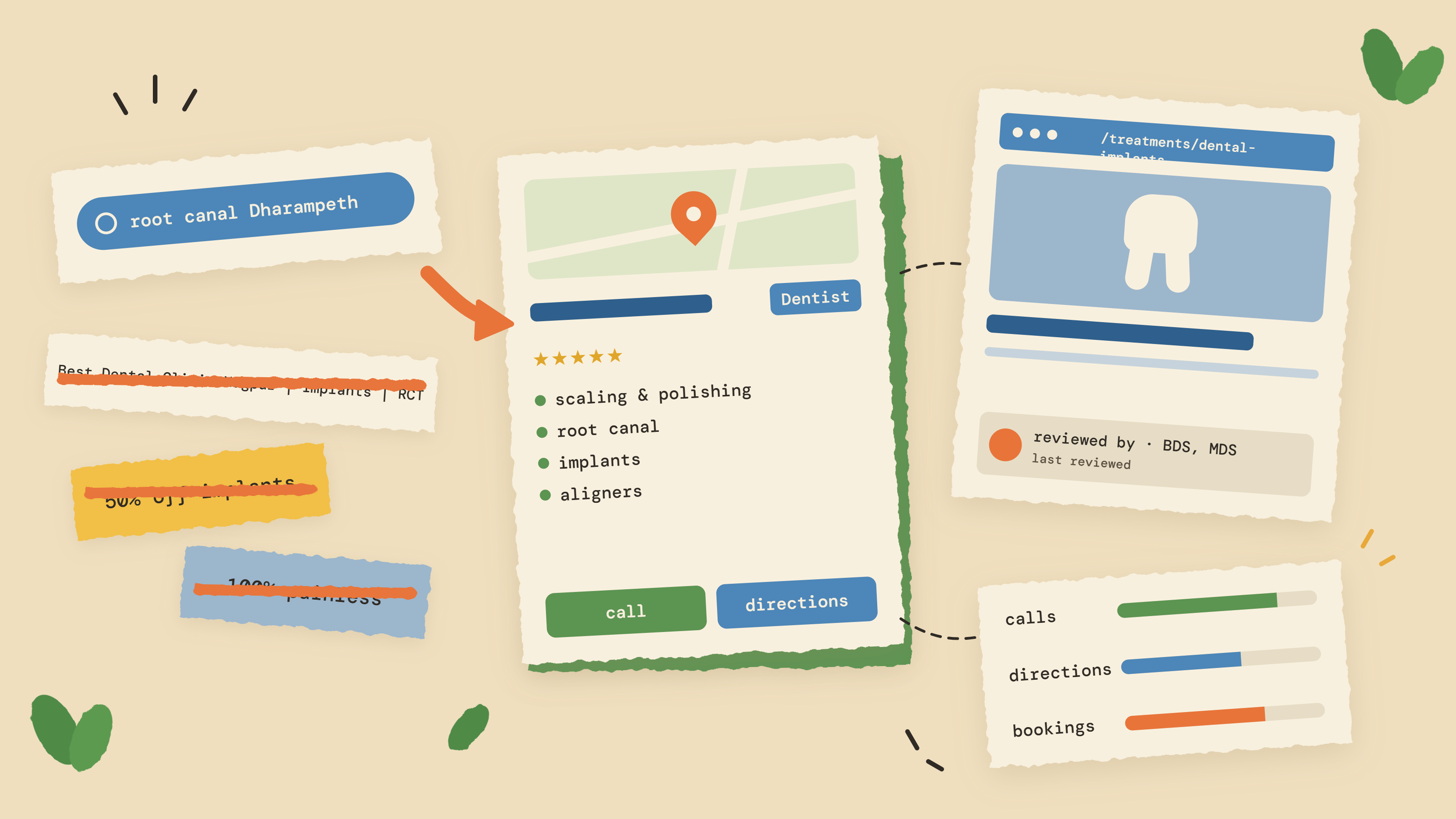
Use your real-world clinic name exactly as it appears on your signboard. Adding "Best Dental Clinic Nagpur | Implants | RCT" to the name breaks Google's rules and can get the profile suspended. Google's guidelines for representing your business say to pick categories that complete "This business IS a", and to use as few as possible. For most practices that is "Dentist" or "Dental clinic" as the primary category, with something like "Orthodontist" or "Cosmetic dentist" only if that genuinely describes the practice.
Doctors and multi-doctor practices
The same guidelines treat doctors and dentists as practitioners. A practice with several doctors should have one profile for the clinic and, if each doctor sees patients directly at that location, separate profiles that carry only the doctor's own name. Do not create extra profiles for each specialisation.
Services, photos, hours and posts
- Add every treatment as a service with a plain description: scaling and polishing, root canal, crowns and bridges, implants, aligners, paediatric dentistry.
- Upload real photos of the signboard, reception, treatment rooms, sterilisation area and team. Skip stock images.
- Keep regular and holiday hours accurate.
- Fill attributes such as wheelchair access and parking.
- Make sure your name, address and phone match on your website, Justdial, Practo and other listings. Our guide to search engine listing on Google, Bing and Indian directories covers that clean-up.
Treatment pages and local landing pages
A single "Services" page listing twenty treatments will not rank for "dental implants in Nagpur". Each major treatment needs its own page.
What a strong treatment page includes
- What the treatment is and who it suits, in plain language.
- What happens at each visit and what recovery looks like.
- An honest cost range, or the factors that change the cost.
- Risks, alternatives and when the treatment is not the right choice.
- The doctor who performs it, with qualifications and registration details.
- A clear way to book: phone, WhatsApp and an online slot picker.
Use a clean URL such as /treatments/dental-implants, a descriptive title tag and headings that match how people search. Our on-page vs off-page SEO checklist lists the technical items, from title tags to internal links.
Area pages without doorway spam
If you have two or three branches, give each one its own location page with its address, map, timings, doctors and directions from nearby landmarks. Do not publish fifty near-identical pages that swap "Sadar" for "Sitabuldi"; Google treats that as doorway content. One genuine page per real location is the rule.
Structured data
Mark up each location with LocalBusiness structured data. Schema.org has a specific Dentist type that sits under both LocalBusiness and MedicalOrganization, so you can describe the clinic's address, hours, phone and doctors in a format search engines read easily. If your site is not indexed at all, fix that first; our guide on why a site is not showing on Google covers the usual causes.
Medical content quality: YMYL and qualified authorship
Health content sits in what Google calls "Your Money or Your Life" territory. Google's page on creating helpful, reliable, people-first content says its systems give even more weight to content with strong signals of experience, expertise, authoritativeness and trust on topics that can affect people's health. It also says trust matters most of all, and strongly encourages accurate bylines that link to information about the author.
For a clinic, that translates into a few concrete habits:
- Every treatment page and article shows who wrote or medically reviewed it: name, degree (BDS, MDS, MCh), registration with the relevant council and years in practice.
- Each doctor has a profile page with real qualifications, memberships and a photo. Never invent a doctor or inflate credentials; Google lists fabricated creator profiles as a sign of low quality.
- Articles answer real patient questions in plain words and match mainstream clinical guidance. No miracle claims, no "painless guaranteed" language.
- Add a "last reviewed" date and actually review pages once a year.
Reviews and patient privacy
Reviews feed directly into prominence, and they are often the deciding factor between two clinics on the same street. The rules here are strict. Google's fake engagement policy bans reviews paid for directly or in kind, so no free cleaning or discount in exchange for a review. It also bans selectively asking only happy patients, reviews from staff or anyone with a conflict of interest, and pressuring people to post while they are still at the clinic.
What works is asking every patient, the same way, with a short WhatsApp message and your review link the day after a visit. A few three-star reviews are normal and make the profile look real.
Replying without breaking confidentiality
When you reply to a review, do not confirm the person is your patient or mention their treatment, even if they did. India's Digital Personal Data Protection Act, 2023 adds to the duty to handle patient data carefully.
A safe reply pattern: "Thank you for taking the time to share this. We would like to understand more; please call the clinic on [number] and ask for the practice manager."
The same caution applies to before and after photos and patient videos. Take written consent, remove identifying details, and check whether the current rules for your profession allow them at all.
Ethics first: India's medical advertising rules
Generic agencies often skip this part. Doctors in India are bound by professional conduct rules that restrict advertising, and state councils do act on complaints.
The Indian Medical Council (Professional Conduct, Etiquette and Ethics) Regulations, 2002 treat soliciting patients, directly or indirectly, as unethical. In 2016 the Maharashtra Medical Council suspended two IVF specialists for three months after repeated advertising, which reportedly included guarantees of treatment and refund offers. The National Medical Commission has since worked on replacement regulations (a 2023 version was notified and then put on hold), so the exact wording in force can change. Dentists come under the Dental Council of India, whose code of ethics also restricts advertising.
We are not lawyers, and these rules are updated, so check the current NMC and DCI rules, or ask your state council, before you launch a campaign. In practice, ethical clinic SEO tends to follow a few safe principles:
- Inform, do not solicit. Factual information (who you are, qualifications, address, timings, treatments offered, what a procedure involves) is very different from "Book now, 50% off implants".
- No guarantees. Avoid "guaranteed results", "100% painless" or "best dentist in the city". They are risky under ethics rules and they also break Google's trust expectations.
- Be careful with testimonials and before and after photos. Professional rules and consent requirements may limit them. Check before you publish.
- Keep credentials accurate. List only degrees and memberships you can prove.
The good news is that SEO fits these limits better than ads do: being findable and answering questions honestly is the core of both. For more on why shortcuts backfire, see white hat vs black hat SEO.
SEO for plastic surgeons and other healthcare clinics
Plastic surgeon SEO follows the same structure with higher stakes. Procedures like rhinoplasty, liposuction or hair transplants involve bigger fees and more anxiety, so patients read more before they call.
- Depth over volume. One thorough page per procedure (candidacy, surgery, recovery, risks, cost factors) beats ten thin ones.
- Surgeon authority. MCh or DNB qualifications, hospital affiliations, society memberships and published work should be visible and accurate.
- Privacy is stricter. Before and after galleries need explicit written consent, cropped or anonymised images, and a check against current professional rules.
The same applies to physiotherapy, dermatology, IVF and eye clinics. Healthcare SEO companies that understand YMYL content and medical ethics build on the same four pillars: profile, treatment pages, credible content and reviews.
What dental SEO services should include
Look past the keyword count. Here is what good seo services for dentists deliver each month, and the red flags.
| Area | What good looks like | Red flag |
|---|---|---|
| Google Business Profile | Correct categories, all services, real photos, weekly posts, review replies, practitioner profiles set up properly | Keywords stuffed into the clinic name, fake listings at addresses you do not occupy |
| Website and technical | Fast mobile pages, indexation checks, schema, click-to-call and WhatsApp buttons | No access to Search Console, or "technical SEO" that is never explained |
| Treatment pages | One page per key treatment, reviewed by your doctor before it goes live | Copy-pasted content from other clinic sites, or AI pages nobody checked |
| Local citations | Consistent details on Practo, Justdial, Sulekha and other relevant directories | Hundreds of spammy directory submissions |
| Reviews | A simple, policy-safe system to ask every patient | Bought reviews, or only asking happy patients |
| Links and mentions | Local news, health association listings, talks, community camps | Paid link packages or private blog networks |
| Reporting | Calls, direction requests, bookings and rankings for treatment terms, every month | Only traffic charts and "impressions", or a promise of number one rankings |
A typical local package for a single clinic covers most of this. Our breakdown of SEO packages for small business in India shows what you should expect at each price level.
Choosing a dental SEO company
Before you sign with a dental SEO company, ask:
- Who owns the accounts? Your profile, Search Console, Analytics and website should be in your name.
- Do you understand medical advertising rules? If they suggest discount campaigns, guarantees or review incentives, walk away.
- Who writes the medical content, and does a doctor review it?
- What do you report? A sample report should show calls and bookings, not just rankings.
- What happens in month one, three and six? Steady local gains usually take three to six months; distrust page one in two weeks.
- Can I leave easily? Prefer monthly or quarterly terms over a 12-month lock-in.
Our guide on how to choose an SEO company in Mumbai and other Indian cities has a longer checklist. For a starting point, our SEO service page offers a free AI and SEO audit of your clinic's site and profile.
Measuring calls and bookings, not just rankings
A dentist SEO service is working when more of the right patients call or book. Track these monthly:
- Profile actions: calls, website clicks and direction requests from the Google Business Profile performance report.
- Website conversions: clicks on the call button, WhatsApp clicks and form submissions, set up as events in Google Analytics.
- Online bookings: appointments booked through your website, tagged by source.
- Treatment-term visibility: where you appear for your ten to fifteen most valuable searches, such as "dental implants" plus your area.
- New patient source: a "How did you find us?" question at reception catches what software misses.
Online booking makes this much easier to measure. Clinic booking software such as our own Book A Sloth lets patients pick a slot from your website or profile link, so each appointment can be tied back to the search that brought it.
A simple worked example: if your profile brings 60 calls a month and reception converts half into appointments, that is about 30 visits. Multiply ten extra visits by your average treatment value, and remember follow-ups and family referrals, to see what better SEO is worth to you.
Getting started with dental SEO services
Start with the free work: claim and complete your Google Business Profile, fix your clinic details across directories, and build one honest page for each treatment, reviewed by the doctor who performs it. Then add a review routine and call tracking. Everything else builds on these.
If you would rather have it handled, our SEO for clinics and local businesses starts at ₹15,000 a month and covers on-page and technical SEO, ten tracked keywords, monthly content optimisation and reporting. See all starting prices on our pricing page, or book a call to talk through your clinic.
Frequently asked questions
What do dental SEO services include?
They usually cover Google Business Profile optimisation, treatment and location pages, technical fixes, local directory listings, a review routine and monthly reporting. Good providers also make sure medical content is reviewed by a qualified dentist. Reporting should focus on calls, direction requests and bookings.
How long does SEO for a dentist take to show results?
Profile fixes and new reviews can lift calls within a few weeks, but steady local ranking gains usually take three to six months. Competitive cities and treatments like implants or aligners take longer. Be wary of any dental SEO company that promises page one in days.
How much do SEO services for dentists cost in India?
Prices vary widely by city, competition and scope. A single clinic's local SEO package often costs less than a multi-branch or plastic surgery practice. At Timewheel, SEO starts from ₹15,000 a month; ask any provider for a written list of monthly deliverables before you compare prices.
Can doctors and dentists in India advertise online?
Professional conduct rules for doctors treat soliciting patients directly or indirectly as unethical, and the Dental Council of India's code also restricts advertising. Factual information about your clinic, qualifications and treatments is generally treated differently from promotional offers. Rules change, so check the current NMC and DCI rules or ask your state council before running campaigns.
Is SEO for plastic surgeons different from dental SEO?
The structure is the same: a strong profile, one detailed page per procedure, credible surgeon information and reviews. Plastic surgeon SEO needs deeper procedure content because patients research longer, and stricter care with before and after photos, consent and privacy.
Should I hire one of the healthcare SEO companies or a general agency?
Specialisation helps less than understanding. Pick any agency that knows Google's health content expectations, Indian medical advertising limits and patient privacy, and that reports on calls and bookings. Ask who writes your medical content and whether your doctor reviews it.
Shubham N Datarkar
Founder, Timewheel
Shubham founds and leads Timewheel, a Nagpur product studio that builds its own software and runs SEO, AI-search and growth for businesses across India. He writes from hands-on work shipping products and measuring what actually moves rankings and revenue.
Comments
Be the first to comment.