Content development services cover the whole job of turning your business knowledge into content that brings in customers: planning what to publish, researching it, writing, editing, designing, optimising it for search, distributing it and refreshing it later. Content creation is only the writing or production step inside that process. If you are hiring help, buy development when you need a plan and a system, and buy creation when you already know exactly what you want written.
This guide explains the terms agencies use, what a proper service includes, how web copywriters differ from SEO copywriters, what Indian businesses typically pay, and how to check quality now that so much content is AI-assisted. If you are new to the basics, start with our guide on what content in writing actually means.
What are content development services?
A content development service is a managed process, not a single deliverable. The provider works out who your customers are, what they search for and ask before buying, and which pages, posts and assets will answer those questions. Then they produce, publish and maintain that content on a schedule.
For a Nagpur clinic, that might mean treatment pages, a monthly blog and WhatsApp-friendly FAQs. For a Shopify store in Pune, it might mean product descriptions, buying guides and Instagram captions. Each piece has a job, a reader and a way to measure it.
Content development vs content creation vs content generation vs content marketing
Agencies use these four phrases loosely. Here is a clear way to separate them.
| Term | What it means | Typical output | Who it suits |
|---|---|---|---|
| Content development | The end-to-end process: strategy, research, production, editing, SEO, publishing and updates | Content plan, calendar, finished pages and posts, refresh schedule | Businesses that need a system, not just articles |
| Content creation | Producing the actual material: writing, design, video, audio | Blog posts, web copy, reels, infographics | Teams that already have a plan and need production capacity |
| Content generation | Producing content at volume, often with templates or AI tools | Product descriptions, drafts, variations, captions in bulk | Large catalogues and repetitive formats, with human review |
| Content marketing | Using content to attract and convert customers, including promotion and measurement | Campaigns, newsletters, social distribution, lead magnets, reporting | Businesses that want content tied to leads and sales |
In practice, content creation services and content generation services are subsets of development, and content marketing is what happens when developed content is promoted and measured against business goals. When an agency says it offers the "best content marketing services", ask which of these four layers is actually in the scope.
What a content development service includes
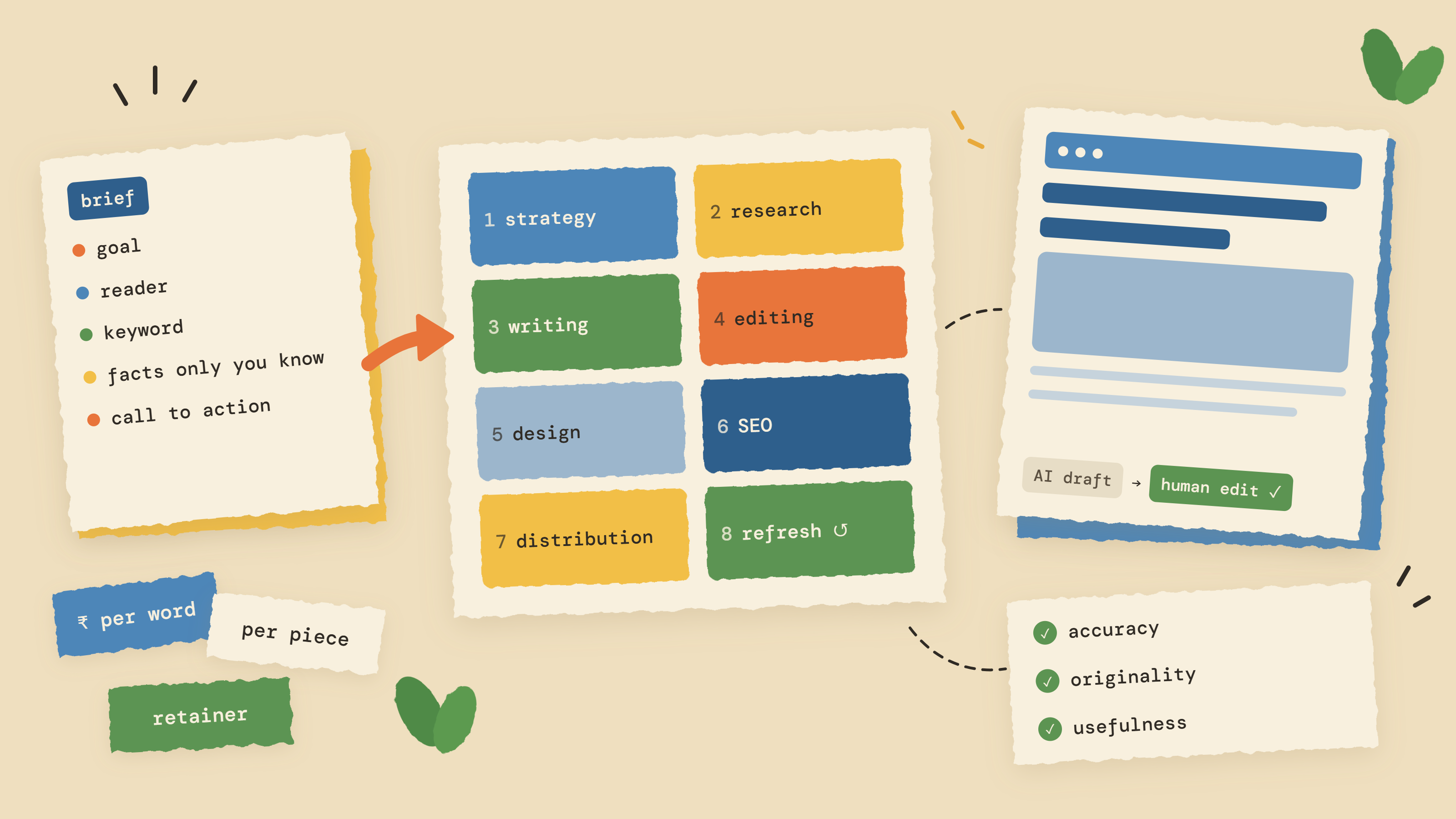
A complete service usually runs through eight stages. Smaller packages drop some of them, which is fine as long as you know which ones are missing.
- Strategy. Goals, audience, offers, tone of voice and which channels matter.
- Research. Keyword research, customer questions, competitor gaps and subject-matter interviews with you or your team.
- Writing. Drafting pages, articles, scripts or captions to an agreed brief.
- Editing. Structural editing, fact-checking, proofreading and a brand-voice pass.
- Design. Formatting, images, tables, infographics and social creatives, so content is readable on a phone.
- SEO. Titles, meta descriptions, headings, internal links and schema, the same items covered in our on-page SEO checklist.
- Distribution. Publishing on your site, sharing on social media, email and WhatsApp broadcasts, and sometimes paid promotion.
- Refresh. Updating prices, dates, screenshots and facts, merging weak posts and improving pages that slip in rankings.
Refresh is the stage most often skipped, so ask how often a provider reviews old content.
Types of content development services
Most Indian businesses need some mix of the following, and each type needs a slightly different skill set.
Copywriting services for websites
Home page, service pages, about page, landing pages and calls to action. Website copy is short, persuasive and tied to a single action: call, WhatsApp, book or buy. It works best when planned alongside the website design, not pasted in afterwards.
Blogs and digital marketing content writing
Articles, guides and comparison posts that answer what customers search for. This is where most organic traffic growth comes from. On our Everything Powerlifting case study, organic keywords grew from 100 to 887 alongside regular content and SEO work. Digital marketing content writing also covers ad copy and email sequences.
Case studies
Structured stories of a real client problem, what you did and the measurable result. They are the most persuasive content for B2B and service businesses, but only if the numbers are real and the client has agreed to be named.
Legal content writing and compliance content
Privacy policies, terms and conditions, refund policies, disclaimers and regulated-industry pages for finance, health, real estate and education. Legal content writing needs a writer who understands the subject, and a final review by a qualified lawyer. Marketing claims also need care: the ASCI Code expects advertising claims to be truthful, substantiated with evidence and free from misleading exaggeration or omission.
Social media content
Captions, carousels, reel scripts, bios and festival creatives. For profile basics, see our Instagram bio examples for businesses, or what a social media marketing service covers.
What is a web copywriter, and how is a copywriter for SEO different?
A web copywriter writes the words on your website and landing pages with one goal: getting the visitor to take action. They think about headlines, benefits, objections, trust signals and the button text. Their success metric is conversion rate.
A copywriter for SEO writes content that ranks in search and then converts. They start from keyword and search intent research, structure pages so Google and AI answer engines can understand them, and write longer, more complete answers. Their success metric is qualified organic traffic and the leads it brings.
| Web copywriter | SEO copywriter | |
|---|---|---|
| Main goal | Conversions on the page | Rankings plus conversions |
| Starts from | Offer, audience, objections | Search intent, keywords, competing pages |
| Key skills | Headlines, persuasion, calls to action | Research, structure, internal linking, metadata |
| Best for | Home page, landing pages, ads | Service pages, blogs, guides, category pages |
For service pages, which must rank and convert, ask candidates for one sample of each. If you want your pages to be quoted by ChatGPT and Google AI as well, our guide to answer engine optimisation explains the extra structure that helps.
How to brief a content team
Most weak content comes from weak briefs: a writer who does not know your customers or prices fills the gaps with generic lines. A good brief takes 20 to 30 minutes and saves rounds of revisions.
Include these items in every brief:
- Goal: what the piece must achieve (enquiries, store visits, demo bookings, ranking for a topic).
- Reader: who they are, what they already know, and what worries them before buying.
- Primary keyword and questions: the main search term plus the questions customers ask you on calls and WhatsApp.
- Facts only you know: prices or price ranges, process, timelines, guarantees you can actually honour, real results.
- Proof: case studies, reviews, certifications and photos the writer may use.
- Tone and language: formal or friendly, English, Hindi, Marathi or Hinglish, words to avoid.
- Examples: two or three pages you like and why.
- Call to action and links: where the reader should go next, and which pages to link.
- Format and deadline: length range, headings, tables, images, review owner and due date.
Here is a short, made-up example for a Nagpur physiotherapy clinic: "Goal: book assessments. Reader: office workers aged 30 to 50 with back pain who fear surgery. Keyword: back pain physiotherapy in Nagpur. Facts: first assessment ₹600, sessions 45 minutes, female physiotherapist available. Tone: reassuring, plain English. CTA: WhatsApp booking." That is enough for a competent writer to produce something specific.
How content development services are priced in India
There is no official rate card. Providers usually charge in one of three ways.
- Per word: common for freelancers and bulk blog work. It rewards length rather than usefulness.
- Per piece: a fixed fee for a blog post, a website page or a case study. Get the scope written down.
- Monthly retainer: a set volume of content plus strategy, SEO and reporting each month.
The ranges below are our estimates of typical Indian market quotes, based on what freelancers and agencies commonly charge for each level of work. They are not survey data, so treat them as a sense-check rather than a price list.
| Model | Typical range (estimate) | What drives the price |
|---|---|---|
| Per word, entry-level or bulk | ₹0.50 to ₹1 per word | Little research, light editing, generic topics |
| Per word, experienced writer | ₹1.50 to ₹4 per word | Original research, SEO structure, an editor's pass |
| Per word, specialist (legal, medical, finance, technical) | ₹4 to ₹8 or more per word | Subject expertise and compliance review |
| Blog post, 1,500 to 2,000 words | ₹2,500 to ₹10,000 per post | Research depth, interviews, images, revisions |
| Website copy, 6 to 8 pages | ₹8,000 to ₹35,000 per project | Number of pages, workshops, conversion focus |
| Case study | ₹5,000 to ₹15,000 per piece | Client interview, data gathering, approvals |
| Monthly retainer | ₹15,000 to ₹75,000 per month | Volume, channels covered, strategy and reporting |
The reasoning: a researched, edited 1,500-word article takes a skilled writer most of a day, plus editing and SEO time, so very low rates usually mean research or editing was skipped. For how content fits inside wider SEO budgets, see what SEO packages include at each price, and for Timewheel's own starting prices, see our pricing page.
How to choose among the best content marketing agencies
Use this checklist when you shortlist content marketing agencies or freelancers.
- Relevant samples: ask for published work in your industry or a similar one, not just polished PDFs.
- Named writers and editors: know who will write and who will edit.
- Research process: ask how they gather facts. Interviews with you are a good sign; "we use tools" alone is not.
- SEO competence: they should talk about search intent, internal links and refreshing old pages, not keyword density.
- Clear scope: word counts, revisions, images, uploads and meta data written into the proposal.
- AI policy: how they use AI tools, who fact-checks, and whether drafts are checked for originality.
- Honest promises: no guaranteed rankings or "page one in 30 days". Our post on white hat vs black hat SEO explains why such guarantees backfire.
- Reporting: monthly numbers on traffic, rankings and enquiries from content, tied to your goals.
- Ownership: you own all content and source files once paid, with no lock-in.
- Trial piece: a paid trial before a long retainer.
Content works best when it is connected to the rest of your marketing. That is why our digital marketing team writes ad copy and landing pages alongside the campaigns, and our SEO service includes monthly content optimisation.
AI-assisted content and Google's guidance on AI-generated content
Almost every content team now uses AI somewhere. The question is whether the result is helpful, accurate and original.
Google's position is clear. Its guidance on AI-generated content says its systems reward original, high-quality content however it is produced, and that using automation mainly to manipulate rankings breaks its spam policies. Its documentation on using generative AI content adds that generative models can produce errors, so output should be fact-checked, and that titles, meta descriptions, structured data and alt text deserve the same review.
The risk is volume without value. Google's spam policies describe scaled content abuse as mass-producing low-value pages to game rankings, including using generative AI to churn out many pages that add nothing. A provider promising 100 AI articles a month for a few thousand rupees is selling exactly that risk.
A sensible AI workflow for an Indian business looks like this:
- Use AI for outlines, summaries, translation drafts and variations, never as the final word.
- Add what only you have: real prices, local details, photos, client results and your own opinion.
- Have a person who knows the subject edit and fact-check every piece.
- Keep a real byline. Google's advice on creating helpful content suggests making clear who created content and explaining how it was made, including any automation, where readers would reasonably wonder.
- Never paste customer personal data or confidential documents into public AI tools.
Quality and plagiarism checks before you publish
Whether you write in-house or hire content creation services, run every piece through these checks before it goes live.
| Check | What to look for |
|---|---|
| Accuracy | Every price, statistic, date and claim is correct and, where possible, linked to its source. |
| Originality | Run a plagiarism checker and read flagged passages yourself. Copied or lightly reworded text is scraping, which Google's spam policies call out. |
| Usefulness | Does it answer the reader's question early and add something competitors do not, such as local details, a table or a worked example? |
| Brand and legal | Claims you can substantiate, no unapproved client names, correct policies and disclaimers. |
| SEO basics | Unique title and meta description, one clear topic, descriptive internal links, clean URL. |
| Calls to action | One obvious next step that works: phone number, WhatsApp link, form or booking page. |
A note on AI detectors: they are not reliable enough to judge quality on their own. Judge the content on accuracy, originality and usefulness instead, which is also how Google says it evaluates pages. If published content still is not appearing in search, our checklist on why a site is not showing on Google covers the usual causes.
Getting started with content development
Start small and measurable: rewrite your five most important pages with a proper brief, add two strong articles a month, and review results after three months.
If you would rather have it planned and produced for you, our digital marketing services combine content, SEO and ads under one plan, or you can book a short call to talk through what your business needs first.
Frequently asked questions
What is the difference between content creation services and content development services?
Content creation services produce the actual material, such as articles, web copy, videos or captions. Content development services include creation but also cover the strategy, research, editing, SEO, publishing and refreshing around it. If you do not yet have a content plan, development is usually the better buy.
What is a web copywriter?
A web copywriter writes the words on websites and landing pages with the aim of getting visitors to act, such as calling, booking or buying. They focus on headlines, benefits, objections and calls to action. An SEO copywriter also works from search intent and keyword research so the page ranks as well as converts.
How much do content writing services cost in India?
Rates vary widely with experience and research depth. As a rough estimate, bulk writers charge around ₹0.50 to ₹1 per word, experienced SEO writers ₹1.50 to ₹4 per word, and specialist legal or medical writers more. Monthly retainers that include strategy and SEO commonly range from about ₹15,000 to ₹75,000.
Does Google penalise AI-generated content?
Google says it rewards original, helpful content however it is produced, so using AI is not a problem in itself. What breaks its spam policies is using AI or automation mainly to manipulate rankings, such as mass-producing pages that add no value. Fact-check AI drafts and add your own expertise before publishing.
How do I choose among the best content marketing agencies?
Ask for published samples in your industry, find out who writes and who edits, and check their research process and AI policy. Avoid anyone guaranteeing rankings. A paid trial piece before a long retainer is the easiest way to judge real quality.
Who should write legal content for my website?
Legal content writing such as privacy policies, terms and refund policies can be drafted by a writer experienced in your industry, but a qualified lawyer should review it before it goes live. Advertising claims on your pages should also be truthful and backed by evidence, in line with the ASCI Code.
Shubham N Datarkar
Founder, Timewheel
Shubham founds and leads Timewheel, a Nagpur product studio that builds its own software and runs SEO, AI-search and growth for businesses across India. He writes from hands-on work shipping products and measuring what actually moves rankings and revenue.
Comments
Be the first to comment.