
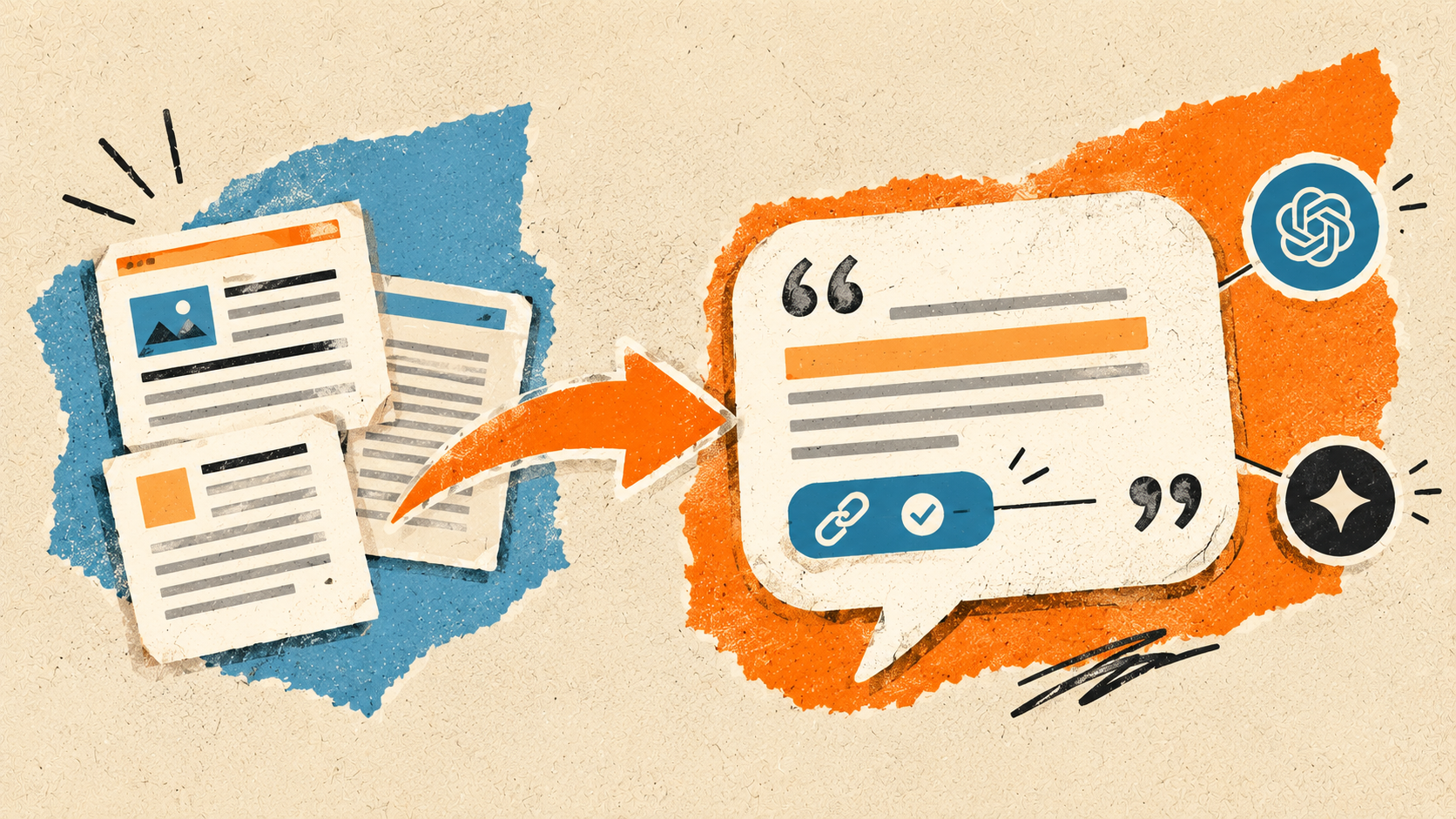
Answer engine optimisation (AEO) is the practice of making your pages easy for AI answer tools, such as Google AI Overviews, AI Mode, ChatGPT search and Perplexity, to find, understand and cite as a source. In practice it is good SEO plus answer-first writing: crawlable pages, clear direct answers, consistent facts about your business, and the right robots.txt settings for AI crawlers. There is no secret markup and no guaranteed way in, but there is a lot you can control.
What is answer engine optimisation, and how is it different from SEO and GEO?
Three terms get used for overlapping work, and the definitions are not standardised. Most of what you read comes from agencies and tool vendors, so treat sharp distinctions with some suspicion. Here is the working split we use.
| Term | Goal | Where it shows up | What you measure |
|---|---|---|---|
| SEO (search engine optimisation) | Rank pages in classic search results | Google and Bing blue links, local pack, Maps | Rankings, impressions, clicks, leads |
| AEO (answer engine optimisation) | Be the answer, or a cited source for it | AI Overviews, AI Mode, featured snippets, ChatGPT search, Perplexity | Citations, mentions, referral visits from AI tools |
| GEO (generative engine optimisation) | Be represented accurately in AI generated responses | Chat assistants, including answers with no link at all | Brand mentions, accuracy of what AI says about you |
AEO and GEO overlap so heavily that many people use them interchangeably (you will also see the American spelling, answer engine optimization). The important point is that both sit on top of SEO, not beside it. If Google cannot crawl and index a page, it cannot cite it. If your site has basic visibility problems, fix those first; our guide on why a site is not showing on Google covers the usual causes.
How Google AI Overviews and AI Mode use your content
Google has published a plain page on AI features and your website, and it is worth reading in full. The short version: AI Overviews and AI Mode show links to supporting pages, and both may run several related searches behind the scenes to build a response. That means they can surface a wider set of sites than the top ten blue links for the original query.
To be eligible as a supporting link, a page must be indexed and eligible to appear in Search with a snippet. Google states there are no additional technical requirements, no special optimisations, and no special schema.org structured data you need to add. In other words, the people selling "AI Overview schema" are selling something Google says does not exist.
What this means in practice
- Crawling and indexing still decide everything. Do not block Googlebot, and keep important content in HTML text, not only inside images or PDFs.
- Snippet controls matter.
nosnippetor a very shortmax-snippetalso limits how your content can appear in AI features. - Traffic is reported with normal search. AI feature clicks count in the Search Console Performance report under the "Web" search type; there is no separate AI Overview report.
- Google-Extended is a different control. It covers use in some of Google's other AI systems, not appearing in Search.
AI Overviews only appear when Google decides they add value. For local searches like "cake shop near Dharampeth", the local pack still matters most, so getting listed on Google, Bing and Indian directories remains basic hygiene.
How ChatGPT search and Perplexity find and cite sources
Both run a crawler for their search features and a separate fetcher for live, user-triggered visits.
OpenAI: three different bots
OpenAI's crawler documentation lists three user agents, and each one does a different job:
- OAI-SearchBot surfaces websites in ChatGPT's search features. If you block it, your pages will not appear in ChatGPT search answers, though they can still show as navigational links.
- GPTBot crawls content that may be used to train OpenAI's foundation models. Blocking it is a training opt-out; it does not remove you from ChatGPT search.
- ChatGPT-User visits a page when a person asks ChatGPT something that needs it. It is user initiated, so robots.txt rules may not apply to it, and it does not decide whether you appear in search.
The settings are independent. You can allow OAI-SearchBot and block GPTBot, which is a sensible middle path for many businesses. OpenAI says robots.txt changes take about 24 hours to affect search results.
Perplexity: PerplexityBot and Perplexity-User
Perplexity's crawler documentation follows the same pattern. PerplexityBot surfaces and links websites in Perplexity search results, and Perplexity says it is not used to crawl content for AI foundation models. Perplexity-User handles live user requests and, by Perplexity's own description, generally ignores robots.txt because a person asked for the page.
One practical trap: if your hosting or a firewall (Cloudflare, a WordPress security plugin, a server rule) blocks unfamiliar bots, you may be invisible to these tools without knowing it. Both OpenAI and Perplexity publish IP ranges so you can allowlist the real crawlers instead of anything claiming their name.
Robots.txt choices for AI crawlers
There is no single right answer. Most Indian SMEs want to be found, so our suggested default is: allow search crawlers, decide separately on training crawlers.
| Your goal | Googlebot | OAI-SearchBot | GPTBot | PerplexityBot |
|---|---|---|---|---|
| Maximum visibility everywhere | Allow | Allow | Allow | Allow |
| Visible in AI search, no model training | Allow | Allow | Disallow | Allow |
| Classic Google only | Allow | Disallow | Disallow | Disallow |
A robots.txt for the middle row looks like this:
User-agent: GPTBotDisallow: /User-agent: OAI-SearchBotAllow: /User-agent: PerplexityBotAllow: /
Never block Googlebot to "stay out of AI Overviews"; that removes you from Google Search entirely. And robots.txt is a request, not a lock: anything private belongs behind a login.
Answer-first writing: the core of AEO
AI tools build responses from passages, not whole pages. A passage that answers a question cleanly in two or three sentences is easy to lift and attribute. A paragraph that warms up for 150 words before saying anything is not. If you want a refresher on the basics, our beginner guide to writing content people actually read applies directly.
A simple pattern for every important page
- Use the question as the heading when it matches how people ask ("How much does SEO cost for a small business in India?").
- Answer in the first one or two sentences under the heading, in full sentences that still make sense if quoted alone.
- Then add the detail: conditions, examples, sourced numbers, exceptions.
- Use tables and lists for comparisons, prices and steps.
- State facts plainly: city, service area, prices "from", hours, and what you do not do.
A worked example, using a hypothetical business. A Nagpur coaching institute's page might currently say "We are a leading institute committed to excellence since many years." An answer-first version says: "XYZ Classes in Sitabuldi, Nagpur, coaches Class 11 and 12 students for JEE Main and NEET. Batches run in Hindi and English, fees start at ₹45,000 a year, and the next batch starts in June." The second version answers four real questions in two sentences. The same thinking drives our guide on SEO for schools and colleges.
Structured data and question sections: useful, not magic
FAQ sections still help, because they put real customer questions and direct answers on the page. The rich result is another story. Google restricted FAQ rich results to well-known government and health websites in 2023, and its Search updates log records that the FAQ rich result stopped appearing in Google Search from May 2026. So do not add FAQs expecting expandable answers under your listing.
Structured data in general still earns its place. Google's introduction to structured data describes it as explicit clues about the meaning of a page. For a local business, the useful types are usually:
- Organization or LocalBusiness: name, logo, address, phone, area served, and
sameAslinks to your official profiles. - Product with price and availability for online stores (see our ecommerce SEO strategies for the full setup on Shopify and WooCommerce).
- Article with a real author for blog posts.
- BreadcrumbList so the site structure is clear.
The rule Google repeats everywhere: markup must match what is visible on the page. Marking up reviews you do not show, or prices that differ from the page, is a fast way to lose trust, not gain it.
Entities and brand mentions: be easy to recognise
AI tools answer questions like "best salon software for a small clinic in India" or "which agency in Nagpur does Shopify" by combining what they find across many sources. You cannot control those sources, but you can make the facts about your business consistent and easy to confirm.
- One name, everywhere. Use the same business name, address and phone number on your website, Google Business Profile, JustDial, IndiaMART, LinkedIn and Instagram.
- A clear About page and author pages that say who you are, where you are and who writes your content.
- Earned mentions: local news, association listings, partner pages and genuine reviews. Slow to build, impossible to fake at scale.
- Specific, checkable claims. "Organic traffic grew from 292 to 889 visits a month" with a link to the Everything Powerlifting case study is something a person or a model can verify. "We are the No. 1 agency" is not.
How to measure AI visibility without fooling yourself
Measurement is the weakest part of AEO today. Answers change between users, sessions and days, so a single screenshot proves very little. Here is a practical setup that costs nothing to start.
- Search Console. Track impressions and clicks for question-style queries and the pages that answer them.
- Analytics referrals. In GA4, check referral traffic from chatgpt.com and perplexity.ai.
- A fixed prompt panel. Write 15 to 25 questions your customers really ask. Monthly, run them in ChatGPT, Perplexity and Google, and record whether you are mentioned, cited or linked, and whether the facts are right.
- Server logs or CDN dashboard. Confirm OAI-SearchBot, PerplexityBot and Googlebot get 200 responses, not 403 errors from a firewall.
- Ask new leads. Add "ChatGPT or another AI tool" to your "How did you hear about us?" field.
Treat paid "AI visibility scores" as directional at best.
SEO automation: what to automate safely, and what not to
SEO automation saves real time on repetitive checks, and AI tools have made drafting faster. But Google's guidance on using generative AI content is clear on two points: generative models do not retrieve facts, so outputs need human fact-checking, and generating many pages without adding value for users may violate the spam policy on scaled content abuse. That gives you a simple dividing line.
| Safe to automate | Keep a human in charge |
|---|---|
| Weekly crawls for broken links, redirects and missing titles | Deciding which pages to create, merge or delete |
| Rank, impression and click reports from Search Console | Interpreting why traffic moved and what to do next |
| Alerts for pages dropping out of the index or robots.txt changes | Robots.txt and AI crawler policy decisions |
| First drafts of meta descriptions and alt text, reviewed before publishing | Final copy, prices, claims and anything legal or medical |
| Generating schema from data you already hold (products, locations) | Checking that the schema matches what the page shows |
| Clustering keyword lists and summarising competitor pages | Choosing the angle and adding first-hand experience |
Do not automate mass-produced city pages with the name swapped, unreviewed AI articles, fake reviews or "automated backlinks". These are the patterns spam policies target, and they say nothing specific enough to be cited. Our breakdown of SEO packages for small businesses shows where automation genuinely saves money.
How can ChatGPT be effectively integrated into social media strategies?
Consistent social profiles reinforce who you are, and posts answering common questions can be reused on your website. ChatGPT helps most as an assistant, not an author.
Good uses
- Idea lists from real questions. Paste anonymised DMs or WhatsApp queries and ask for post ideas that answer them.
- Repurposing. Turn a blog section into a carousel outline and a Reel script, then edit in your own voice.
- Caption variations and Hindi or Marathi drafts for A/B testing, checked by a fluent speaker. Our list of Instagram bio lines in Hindi shows how much tone matters.
- Monthly calendars built around festivals, sales and launches, which you then adjust for your city and audience.
Guardrails
- Never paste customer personal data, unpublished financials or passwords into a chatbot.
- Fact-check every price, date, offer and health or finance claim before posting.
- Do not let it invent testimonials, results or statistics.
- Keep a short brand voice note (words you use, words you avoid) and give it to the tool every time.
If you want a team to run this end to end, our social media marketing service starts at ₹10,000 a month for 12 to 15 posts on two platforms.
Your answer engine optimisation checklist
- Confirm key pages are indexed and not set to
nosnippet. - Review robots.txt and firewall rules for Googlebot, OAI-SearchBot, GPTBot and PerplexityBot.
- Rewrite the opening of your top 10 pages to answer the main question in two or three sentences.
- Add question sections built from real customer queries.
- Add Organization or LocalBusiness schema that matches the visible page.
- Make your name, address and phone identical across your site and listings.
- Publish specific, verifiable proof: case studies, prices "from", credentials.
- Run a monthly prompt panel and track AI referrals in GA4.
Paid channels still matter while you build this organic visibility. Search and Meta ads can capture demand today, which is where a digital marketing team in Nagpur fits alongside SEO, and our case studies show what both look like with real numbers.
If you would like a second pair of eyes, start with the free AI + SEO audit on our SEO company in Nagpur page. It is a quick way to see where your site stands in both classic and AI search, and our ongoing SEO service starts at ₹15,000 a month.
Frequently asked questions
Is answer engine optimisation different from SEO?
AEO builds on SEO rather than replacing it. Classic SEO gets pages indexed and ranked; AEO focuses on making passages clear and trustworthy enough to be quoted or cited in AI answers. If your SEO basics are broken, AEO work will not help much.
Do I need special schema to appear in Google AI Overviews?
No. Google's AI features documentation says there is no special schema.org structured data or extra technical requirement. A page needs to be indexed and eligible to show with a snippet. Normal structured data that matches your visible content still helps Google understand the page.
Should I block GPTBot in robots.txt?
Blocking GPTBot tells OpenAI not to use your content for training its models, but it does not remove you from ChatGPT search. Search visibility is controlled by OAI-SearchBot. Many businesses allow OAI-SearchBot and decide on GPTBot based on how they feel about training use.
What can be automated in SEO safely?
SEO automation works well for crawls, broken link checks, index alerts, reporting and first drafts of meta descriptions that a person reviews. Strategy, final copy, claims, prices and robots.txt decisions should stay with a human. Mass-produced pages without real value can breach Google's scaled content abuse policy.
How can ChatGPT be effectively integrated into social media strategies?
Use ChatGPT to turn real customer questions into post ideas, repurpose blog content into captions and scripts, and draft calendars and language variations. Always edit in your brand voice, fact-check prices and claims, and never paste customer personal data into the tool.
How do I know if ChatGPT or Perplexity is citing my website?
Check GA4 for referral traffic from chatgpt.com and perplexity.ai, and run a fixed set of customer questions in each tool every month, noting whether you are mentioned or linked. Server logs can confirm their crawlers reach your pages. Answers vary between sessions, so look at trends, not single screenshots.
Shubham N Datarkar
Founder, Timewheel
Shubham founds and leads Timewheel, a Nagpur product studio that builds its own software and runs SEO, AI-search and growth for businesses across India. He writes from hands-on work shipping products and measuring what actually moves rankings and revenue.
Comments
Be the first to comment.