
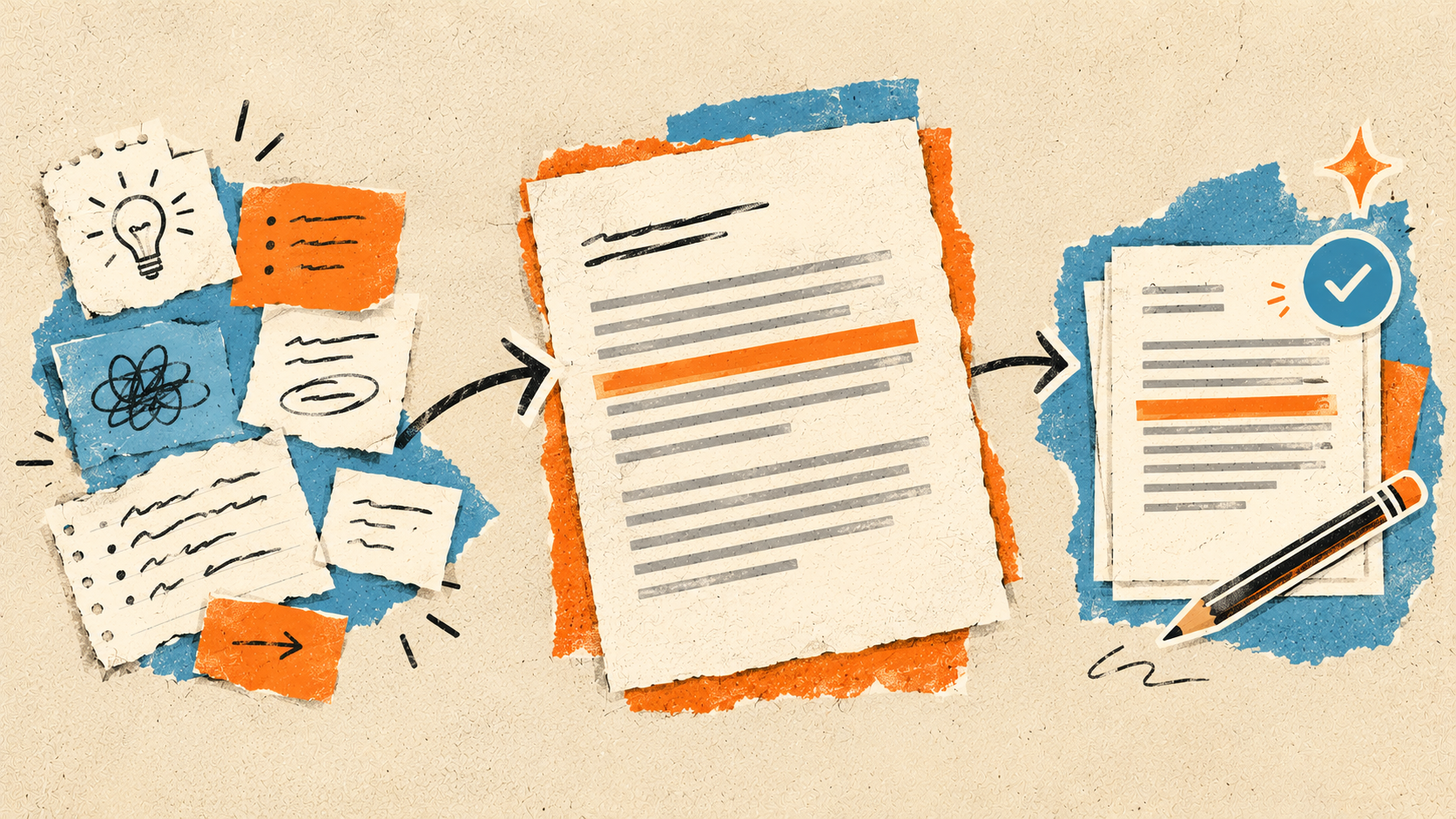
Content in writing is the substance of a piece: the ideas, facts, arguments, examples and advice it carries, as opposed to its style (how it is said) and its mechanics (spelling and grammar). When business owners ask what is content in writing, they usually also mean content writing, the practice of producing blogs, web pages, emails and social posts that help a specific reader understand something or take a step. Good content starts with something worth saying, then says it clearly.
This guide is for beginners: a Nagpur shop owner writing their own blog, a marketer handed the company website, or a student exploring content as a career.
What is content in writing? Substance versus form
Every piece of writing has layers. The content is what you are saying: the claim, the information, the example, the answer. The form is how you say it: word choice, tone, sentence length, structure and formatting. Teachers usually add a third layer, mechanics, which covers spelling, punctuation and grammar.
Beginners often polish sentences in a post that has nothing new to say. A plain sentence with a useful fact beats a beautiful sentence with none. Fix content first, then form, then mechanics.
| Layer | What it covers | Question to ask yourself |
|---|---|---|
| Content | Ideas, facts, examples, answers, proof | What will the reader know or be able to do after reading? |
| Form and style | Structure, tone, word choice, headings, length | Is this the clearest, easiest way to say it for this reader? |
| Mechanics | Spelling, grammar, punctuation, names, numbers | Is anything wrong that would make a reader stop trusting me? |
In marketing, "content" also means any published asset: a reel, a carousel, a product page. The asset is only as good as the substance inside it.
Types of written content you will come across
- Blog posts and guides: answer a question in depth, like this one.
- Website copy: home, service and about pages. Short, persuasive and focused on one action.
- Product descriptions: specifications plus the reason to buy.
- Social media captions and bios: short, conversational and personal. Our Instagram bio ideas in Hindi show how much a few words can carry.
- Emails and WhatsApp broadcasts: written for people who already know you, so they can be more direct.
- Ad copy: headlines and descriptions for Google and Meta ads, judged by clicks, leads and cost.
- Case studies and white papers: proof-led long-form content for B2B buyers.
- Feature and magazine articles: story-led non-fiction built around people, places or trends.
Content writing for beginners: a five-step process
You do not need natural talent to write useful content. You need a process you repeat. This one works for almost every format.
1. Pick one reader
Write for one person, not "everyone". A dentist writing for "patients" is vague. Writing for "a parent whose eight year old needs braces and who is worried about cost" tells you which questions to answer, which words to use and what to leave out.
2. Find your angle
An angle is the specific take that makes your piece worth reading when ten others already exist. Read the top Google results and look for what they miss: local prices, a worked example, a mistake you have seen first hand, a checklist. Your angle lives in that gap.
3. Outline before you draft
Write your headings as the questions a reader would ask, in the order they would ask them. Under each, jot the one point you must make and the proof you will use: a number, an example or a source. If a heading has no point, cut it. A good outline is half the article.
4. Draft fast, answer first
Put the direct answer in the first two or three sentences, then expand. Draft in one sitting without editing. Use short paragraphs, everyday words and concrete examples. If you would not say a sentence out loud to a customer across the counter, rewrite it.
5. Edit in three passes
- Content pass: Is every claim true and supported? Is anything missing that the reader needs to act?
- Clarity pass: Cut filler, split long sentences, replace jargon with plain words.
- Mechanics pass: Read it aloud. Check spelling, names, prices, dates and every link.
Students who want to go deeper into digital marketing skills, content included, can explore the Timewheel Academy.
What can you do to make a headline more compelling?
The headline decides whether anything else gets read. Adobe's guide to writing better headlines puts it simply: a headline is a promise, and the article has to keep it.
- Be specific. "How to Write Content" is vague. "How to Write Your First Blog Post in 90 Minutes" tells the reader exactly what they get.
- Use a number when the piece has a structure. "7 Mistakes" or "5 Steps" sets expectations.
- Name the reader or the situation. "for Clinic Owners" or "for First-Time Shopify Sellers" makes the right person stop scrolling.
- Put the important words first. People scan headlines, and Adobe notes that the first and last words matter most.
- Use words people actually search. Plain wording beats clever wordplay that nobody types into Google.
- Write ten versions, then pick one. Your first headline is rarely your best.
- Never overpromise. Google's people-first guidance asks whether a headline avoids being exaggerated or shocking.
For the SEO title tag specifically, Google's title link guidelines recommend titles that are descriptive and concise, unique to each page and free of repeated keywords. Keep the main phrase near the start and your brand name at the end.
Creative writing vs content writing vs feature articles
| Creative writing | Content writing | Feature or magazine article | |
|---|---|---|---|
| Main goal | Express, entertain, move the reader | Inform and help the reader act | Tell a true story that explains something bigger |
| Typical forms | Stories, poems, scripts | Blogs, web pages, product pages, emails | Profiles, trend pieces, long reads |
| Structure | Follows the story | Answer first, scannable headings | Opening scene, context, closing that echoes the opening |
| Research | Imagination and observation | Search intent, sources, data | Interviews, reporting, fact-checking |
| Success looks like | Emotional impact | Traffic, enquiries, sales | Readers finish it and share it |
How to write creative writing
Creative writing rewards showing over telling. Start with a concrete image or moment, give your characters a want and an obstacle, and cut anything that does not move the piece forward. Read widely in your chosen form and write regularly. Storytelling pays off in marketing too, for example inside a case study.
How to write a feature
A feature is non-fiction that reads like a story. Pick a person or place that represents a larger trend, for example a Sitabuldi tailor who now takes many of his orders through Instagram. Open with a scene, then widen out with a "nut graf", the paragraph that tells readers why this story matters now. Add real interview quotes and context, and end on a line that echoes the opening.
How to write an article for a magazine
Read several recent issues first to learn the tone, typical length and sections. Many editors prefer a short pitch: a working headline, a two-line summary, why it matters now and who you will interview. Once commissioned, respect the word count and deadline, and keep notes that back up every fact.
What information should not be included in blogs?
What you leave out matters as much as what you write. These categories can cause legal, reputational or search trouble.
- Other people's personal data. Customer names, phone numbers, addresses, order details or chat screenshots should never appear without clear consent. India's Digital Personal Data Protection Act, 2023 puts duties on anyone who processes personal data.
- Unverified claims. "No. 1 clinic in the city", "guaranteed results" or a statistic you cannot trace. The ASCI Code says factual claims in advertising should be capable of substantiation. Hold your blog to the same standard, and take extra care with health, money and legal topics.
- Copyrighted material. Images pulled from a Google image search, paragraphs lifted from a competitor, song lyrics, paid research reports. Quote briefly with credit, or use your own photos and words. Google's spam policies also target scraped content and copied text that has only been lightly reworded.
- Confidential business information. Client names under NDA, contract terms, internal revenue, unreleased products and supplier details.
- Security details. Admin URLs, logins in screenshots or anyone's home address.
- Outdated information. Old prices, discontinued services and expired offers. Update the post or remove it.
- Keyword stuffing and filler. Repeating a phrase in the hope of ranking. Google's SEO Starter Guide says keyword stuffing is against its spam policies and tiring for readers.
A simple test: would the customer, client or competitor mentioned be comfortable reading it? If not, rewrite it.
SEO content writing example: before and after
Most SEO content writing samples show only the finished version, but seeing the edit teaches more. Here is a short example we wrote for an imaginary physiotherapy clinic targeting the search "back pain physiotherapy Nagpur". The clinic, area and price are made up for illustration.
Before
Back pain physiotherapy Nagpur is our speciality. We are the best back pain physiotherapy clinic in Nagpur and our back pain physiotherapy Nagpur treatment is world class. Contact us for back pain physiotherapy in Nagpur today.
After
Back pain physiotherapy in Nagpur: what your first visit looks like
If your lower back aches after long hours at a desk or on a two-wheeler, your physiotherapist will first check how you move, where it hurts and what makes it worse. Your first 45 minute session at our Ramdaspeth clinic includes that assessment, one hands-on treatment and three exercises to do at home. How many sessions you need depends on what the assessment finds, and we will tell you on day one. Each session costs ₹600. Call or WhatsApp us to book a morning or evening slot.
What changed
- The search phrase appears once, naturally, in the heading instead of four times in a row.
- It speaks to a specific reader (desk workers and two-wheeler riders) and their real worry.
- It answers the questions people actually have: what happens, how long, how many sessions, how much.
- Empty claims like "best" and "world class" are replaced with facts a reader can check.
That is the whole idea behind a good SEO content writing example: write for the person first, then make sure the words they search for appear where they naturally belong. If your pages read well but still do not appear in search, the cause is often technical. Our guide on why your site is not showing on Google walks through the usual reasons.
How to create powerful content that matters: Google's people-first test
Google's guidance on creating helpful, reliable, people-first content is the best free brief a content writer can get. It explains that Google's systems aim to reward content made for people rather than content made mainly to rank. A few of its self-assessment questions, paraphrased:
- Does the content offer original information, reporting, research or analysis?
- Does it add real value compared with other pages already in the search results?
- Will a reader leave feeling they learned enough to reach their goal?
- Is it clear who wrote it, and do they show genuine experience or expertise?
- Does the headline describe the content without exaggeration?
The same page lists warning signs of search-engine-first content, including writing to a particular word count (Google says it does not have a preferred one), chasing trending topics you know little about, and heavy automation with little human oversight. Of experience, expertise, authoritativeness and trustworthiness, Google says trust matters most. Google's starter guide adds the practical side: easy to read, well organised, unique and up to date.
For a small business, this is good news. You already have what generic content lacks: first-hand experience. A bakery owner knows which cake designs survive a Nagpur summer delivery. A coaching institute knows exactly which doubts students bring in the weeks before exams. Write that down and you have content that matters. Our guides on SEO for educational institutions and ecommerce SEO strategies show how this plays out in two very different industries, and in our Everything Powerlifting case study, organic traffic grew from 292 to 889 visits a month as ranking keywords rose from 100 to 887.
Content writing books worth reading
These well-known titles are worth more than a hundred blog posts about writing.
- Everybody Writes by Ann Handley (2nd edition, Wiley, 2022): the most practical guide to marketing writing, from the first draft to publishing.
- On Writing Well by William Zinsser (first published 1976): the classic guide to clear non-fiction, especially strong on cutting clutter.
- Made to Stick by Chip Heath and Dan Heath (2007): why some ideas are remembered and others vanish, with a simple framework you can apply to any message.
- The Elements of Style by William Strunk Jr. and E. B. White: a short rulebook on concise, correct English.
- Bird by Bird by Anne Lamott (1994): a warm, honest book about building the habit of writing.
Where to go from here
Start small. Pick one question your customers ask every week and answer it in a single post using the five steps above. Repeat weekly, and keep a list of the questions that come up in calls, on WhatsApp and in your social media comments. More practical guides are on the Timewheel blog, and if you are weighing up outside help, our post on SEO packages for small businesses explains what to expect.
If you would rather have it done, our SEO service in Nagpur covers on-page and technical SEO with monthly content optimisation from ₹15,000 a month, and you can start with a free AI and SEO audit. If you want leads while your content builds up, our digital marketing team runs Google and Meta ads from ₹8,000 a month plus ad spend.
Frequently asked questions
What is content in writing in simple words?
Content is what a piece of writing actually says: its ideas, information, examples and answers. Style is how it is said, and mechanics are spelling and grammar. Readers come for the content, so it should be worked on first.
How do I start content writing as a beginner?
Pick one topic you know well and one specific reader. Read the top Google results for that topic, find what they miss, outline your headings as reader questions, draft quickly with the answer first, then edit for accuracy, clarity and mechanics. Publish, then repeat weekly.
What can you do to make a headline more compelling?
Make it specific, add a number if the piece has a list structure, name the reader or situation, and put the most important words first. Write several versions and pick the clearest. Most importantly, make sure the article delivers exactly what the headline promises.
What information should not be included in blogs?
Avoid other people's personal data without consent, claims you cannot prove, copyrighted images or text you do not have rights to, confidential client or business details, security information and outdated prices or offers. Keyword stuffing also hurts both readers and rankings.
What is the difference between content writing and creative writing?
Creative writing aims to express and entertain through stories, poems or scripts. Content writing aims to inform and help a reader act, usually through blogs, web pages and emails, and is often shaped by search intent. Many content writers use creative techniques such as storytelling to make their work memorable.
Which books are best for learning content writing?
Everybody Writes by Ann Handley is the most practical book on marketing writing. On Writing Well by William Zinsser teaches clear non-fiction, Made to Stick by Chip and Dan Heath explains memorable messages, and The Elements of Style by Strunk and White covers concise English.
Shubham N Datarkar
Founder, Timewheel
Shubham founds and leads Timewheel, a Nagpur product studio that builds its own software and runs SEO, AI-search and growth for businesses across India. He writes from hands-on work shipping products and measuring what actually moves rankings and revenue.
Comments
Be the first to comment.