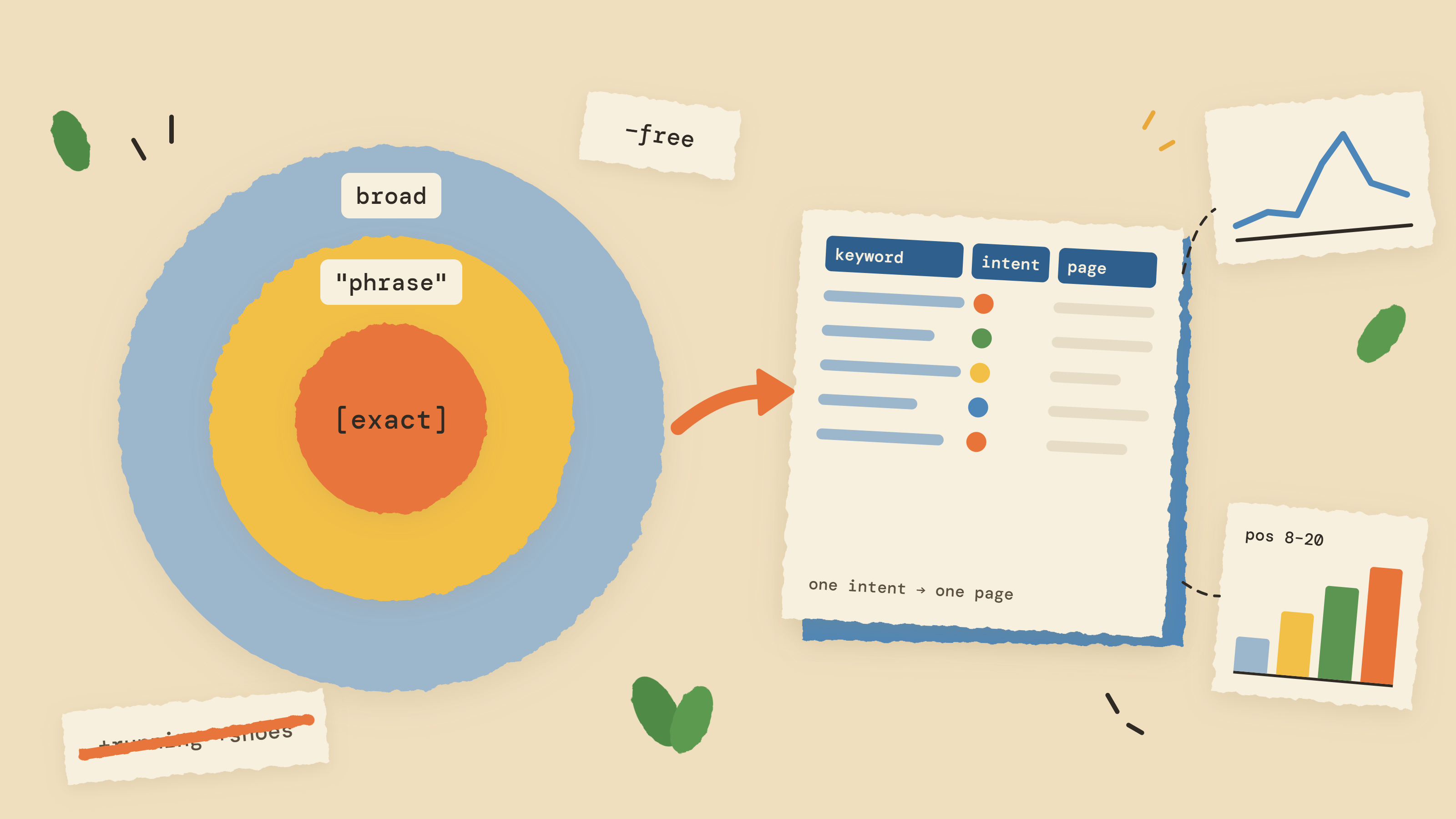
Keyword match types are the three settings in Google Ads (broad, phrase and exact) that decide how closely a person's search must relate to your keyword before your ad can show. Broad match reaches the widest set of related searches, phrase match shows for searches that carry your keyword's meaning, and exact match shows only for searches with the same meaning or intent. SEO keyword research uses the same raw material but works differently, so this guide covers both, plus the free tools and competitor checks that make the job simple.
Types of keywords in digital marketing
Marketers sort keywords in several ways at once. A search like "cake shop near me open now" is transactional in intent, long-tail in length and local in scope. Knowing the type tells you what kind of page or ad will satisfy it.
| Type | What it means | Indian example | Best matched with |
|---|---|---|---|
| Informational | Wants to learn something | how to start a home bakery | Blog post, guide, video |
| Navigational | Wants a specific site | irctc login | Homepage or login page |
| Commercial | Comparing before buying | best accounting software for small business | Comparison page, case studies |
| Transactional | Ready to buy, book or call | buy cotton kurti online | Product or booking page |
| Short-tail | One or two words, vague intent | shoes | Category pages; tough for small sites |
| Long-tail | Three or more words, clear intent | waterproof trekking shoes for women under 3000 | Specific product or blog pages |
| Branded | Contains a brand name | tanishq gold rate today | Brand pages, branded ads |
| Local | Includes a city, area or "near me" | dentist in dharampeth nagpur | Location pages, Google Business Profile |
For most small businesses the money sits in long-tail transactional and local keywords: fewer searches, but the person already knows what they want. If local searches matter to you, pair keyword work with proper listings, as covered in our guide to search engine listing on Google, Bing and Indian directories.
Google Ads keyword match types: broad, phrase and exact
Match types only exist in paid search. They tell Google how much freedom it has when matching your keyword to real searches. According to Google Ads Help on keyword matching options, broader match types capture all the searches of the narrower ones, plus more.
Broad match (no symbol)
Broad match is the default for every keyword you add. Your ad can show on related searches, including some that do not contain your keyword's words at all. Google's example: the broad keyword low carb diet plan may show for "carb free foods" and "mediterranean diet books".
That reach works when conversion tracking is set up, and Google says it is critical to use Smart Bidding with broad match. Without it, broad match can spend your budget on loosely related searches.
Phrase match ("quotation marks")
Phrase match shows your ad on searches that include the meaning of your keyword, including more specific versions. The keyword "tennis shoes" can match "buy tennis shoes for kids" but not "tennis racket".
Word order still counts when it changes the meaning. In Google's note on changes to phrase match and broad match modifier, "moving services NYC to Boston" does not match a search for moving from Boston to New York. Likewise, "packers and movers nagpur to pune" should not show for someone moving from Pune to Nagpur.
Exact match [square brackets]
Exact match gives the most control and the smallest reach. Your ad can show on searches with the same meaning or intent, so [red shoe] can match "red shoes" but not "red sandals". It is no longer literally exact, which is why the search terms report deserves a weekly look.
What happened to broad match modifier?
Broad match modifier (written as +running +shoes) was retired in 2021. Google folded its behaviour into phrase match between February and July 2021. Old BMM keywords still serve but behave as phrase match, and you cannot add new ones. Any guide that still recommends the plus sign is out of date.
Negative keywords and which match type to pick
Negative keywords stop your ad showing on searches containing a term. A tuition centre might add "free" and "jobs" so it does not pay for clicks from people wanting free notes or teaching jobs. Add plurals and misspellings yourself, since negatives do not cover close variants.
- Small budget, no conversion data: start with phrase and exact match on your best long-tail keywords.
- Tracking working, around 30 or more conversions a month: test broad match with Smart Bidding (a common rule of thumb, not a Google requirement).
- Proven winners: keep them in exact match with a steady budget.
If you would rather hand this over, our Google and Meta ads service starts at ₹8,000 a month plus ad spend.
How SEO keyword research differs
SEO has no match types. You cannot tell Google to rank your page only for exact searches. Google reads the page and decides which queries it answers, so SEO keyword research is about choosing topics and writing pages that fully satisfy a search.
The Google SEO Starter Guide says Google's language matching systems can understand how a page relates to many queries, so you need not anticipate every variation. It also confirms Google ignores the keywords meta tag.
- Ads: keyword, match type, bid and ad. Results start the day you switch on and stop when you stop paying.
- SEO: one primary keyword per page, related questions covered naturally, rankings earned over months without a per-click cost.
Search terms that convert in ads are often the best keywords to target with a page. Once you have chosen, the on-page side (titles, headings, internal links) is covered in our on-page vs off-page SEO checklist.
A simple keyword research process in 7 steps
A spreadsheet and the free tools below are enough for a local business or small online store.
- List seed topics: products, services, locations and problems customers mention. A Nagpur interior designer might start with "modular kitchen", "office interior" and "Nagpur".
- Expand with autocomplete in Google, YouTube and Amazon, or an autocomplete tool that checks several at once.
- Add volume and cost from Google Keyword Planner for India or your city.
- Tag intent using the table above.
- Check the results page. If the top results are all marketplaces or government sites, a small site will struggle. Blogs and local businesses mean you have a chance.
- Group and map: cluster keywords that share one intent and assign each cluster to one page.
- Review after 8 to 12 weeks in Search Console and improve pages sitting on page two.
For online stores, our post on ecommerce SEO strategies for Shopify and WooCommerce shows how to map keywords to collections.
Free keyword research tools worth your time
Google Keyword Planner
Keyword Planner sits inside Google Ads under Tools. It suggests keyword ideas, estimates monthly searches and shows the likely cost to bid. Google asks you to complete account setup, including billing details, but you do not have to run a campaign. Low-spend accounts usually see volumes as ranges rather than exact numbers, which is still enough to compare keywords.
Its most underused feature is "Start with a website": enter a competitor's URL and Google suggests keywords related to that site's content.
Google Search Console
The Search Console Performance report lists the queries and pages your site already appears for, with clicks, impressions, click-through rate and average position. Sort by impressions and look for queries at positions 8 to 20: a better title or an internal link often moves them. Zero impressions usually points to an indexing problem; see why your site is not showing on Google.
Google Trends
Google Trends shows relative interest over time, not volume. Use it to compare phrasings ("modular kitchen" vs "kitchen interior"), spot seasonal peaks such as rakhi gifts in July and August, and see which states search a term most. Publish a month or two before the peak.
Soovle and other autocomplete tools
Soovle is a free tool that pulls autocomplete suggestions from several sites at once. Its domain now redirects to Soovle on SEO.com, which says the tool is now owned by SEO.com and remains free. You can pick up to six sources, such as Google, Bing, YouTube, Amazon and Wikipedia, star ideas and export them. It shows no search volume, so treat it as an idea generator.
Keyword shuffle and permutation tools
A keyword shuffle tool combines word lists. Feed it "plumber, electrician" and "Nagpur, Wardha" and it returns every combination, such as "plumber Nagpur" and "Nagpur plumber".
Honestly, their value has shrunk. Phrase and exact match already cover reordered words with the same meaning, so ad accounts rarely need every permutation. For SEO, never build a page per combination: thin near-duplicate city pages can count as doorway pages, as our guide to white hat vs black hat SEO explains.
Bing Webmaster Tools reports
Bing is a smaller audience in India than Google, but its webmaster console is free and often surfaces queries you will not notice elsewhere. The Search Performance report shows clicks, impressions, CTR, keywords and pages, and Bing expanded that report from 6 to 16 months of data. These Bing SERP reports let you compare periods and see which pages served for each keyword. The console also has a Keyword Research tool with Bing volumes and a backlinks report, and you can import verified sites from Search Console.
Keyword proximity in SEO: does it still matter?
Keyword proximity means how close the words of a search phrase sit to each other on a page. The old theory said "cake delivery Nagpur" written together beats the three words scattered across paragraphs, and some tools still score it.
It is a concept from simpler text-matching days. Google now understands meaning and context, and its Starter Guide warns that excessively repeating words, even in variations, tires readers, while keyword stuffing breaks its spam policies. Put your main phrase naturally in the title, one heading and the opening lines, then write for the reader. Our guide on writing content people actually read covers that habit.
Hashtags for SEO: where they help and where they do not
Hashtags are a discovery tool inside social platforms. On Instagram, YouTube, LinkedIn and X they group posts by topic for people browsing it. They are not a Google ranking factor, and adding hashtags to a blog post or product page does nothing for its rankings.
- Social platforms: use a few specific hashtags (#nagpurfoodie, not #food) and descriptive captions with real keywords.
- YouTube: hashtags help viewers find related videos, but the title and description carry the weight.
- Your website: skip hashtags; use clear headings and text.
So "SEO hashtags" really means social search optimisation. For Instagram growth, see how to get 10K Instagram followers.
How to find website competitors
Search competitors are not always business competitors. A sweet shop competes with the shop down the road for walk-ins, but online it may compete with a food blog and a marketplace for the same keyword.
- Search your top 10 keywords in an incognito window and note domains that appear more than twice.
- Check the map pack for local keywords.
- Run Keyword Planner's "Start with a website" on each competitor.
- Look at their ads in the free Google Ads Transparency Center and Meta Ad Library.
- Ask customers who else they considered.
SpyFu alternatives
SpyFu estimates the paid and organic keywords a competitor ranks or bids on. Paid alternatives include Semrush, Ahrefs, SE Ranking, Moz and Similarweb, and Ubersuggest has a limited free tier. Each estimates traffic from its own data, so treat numbers as directional. On a tight budget, the free method above plus Search Console covers most needs.
A simple SEO competitor analysis template
Copy this into a sheet, one column per competitor. Three to five competitors are usually enough to see patterns.
| Check | Competitor A | Competitor B | Your site |
|---|---|---|---|
| Your keywords where they rank top 10 | |||
| Main ranking pages (service, location, blog) | |||
| Topics they cover that you do not | |||
| Google Business Profile reviews and rating | |||
| Page speed and mobile experience | |||
| Running Google or Meta ads? | |||
| One thing you can do better |
The last row matters most. End with a short action list: three pages to write, two to improve, one listing to fix. For a sense of what steady keyword and content work can do, Everything Powerlifting grew from 292 to 889 organic visits a month and from 100 to 887 ranking keywords.
Where to go from here
Pick ten long-tail keywords, map each to a page, check Search Console in two months and repeat. If you want help, our SEO service in Nagpur starts at ₹15,000 a month with 10 tracked keywords; compare tiers in SEO packages for small business or on our pricing page. You can also request the free AI and SEO audit from the SEO page to see which keywords your site can realistically win.
Frequently asked questions
What are the 3 keyword match types in Google Ads?
Broad match, phrase match and exact match. Broad match (no symbol) shows ads on related searches, phrase match (in quotes) on searches that include your keyword's meaning, and exact match (in square brackets) on searches with the same meaning or intent. Broad match is the default for new keywords.
Is broad match modifier still available?
No. Google merged broad match modifier into phrase match between February and July 2021. Existing BMM keywords still run but behave as phrase match, and you cannot create new keywords with the plus sign notation.
What are the types of keywords in digital marketing?
Keywords are usually grouped by intent (informational, navigational, commercial, transactional), by length (short-tail and long-tail), and by scope (branded and local). One keyword often fits several groups, such as a long-tail local transactional search like 'dentist in dharampeth nagpur'.
Do hashtags help SEO?
Hashtags help people discover posts inside social platforms such as Instagram, YouTube and LinkedIn. They are not a Google ranking factor for websites, so adding hashtags to blog posts or product pages does not improve Google rankings. Use clear headings and descriptive text on your site instead.
How do I find my website's competitors for free?
Search your top keywords in an incognito window set to your city and note the domains that keep appearing, including in the map pack. Then use Google Keyword Planner's 'Start with a website' option on each one and check the Google Ads Transparency Center and Meta Ad Library to see their ads.
What is Soovle used for?
Soovle is a free autocomplete tool that shows search suggestions from up to six sources at once, such as Google, Bing, YouTube, Amazon and Wikipedia. It is now owned by SEO.com. It does not show search volume, so use it for ideas and check volumes in Keyword Planner.
Shubham N Datarkar
Founder, Timewheel
Shubham founds and leads Timewheel, a Nagpur product studio that builds its own software and runs SEO, AI-search and growth for businesses across India. He writes from hands-on work shipping products and measuring what actually moves rankings and revenue.
Comments
Be the first to comment.