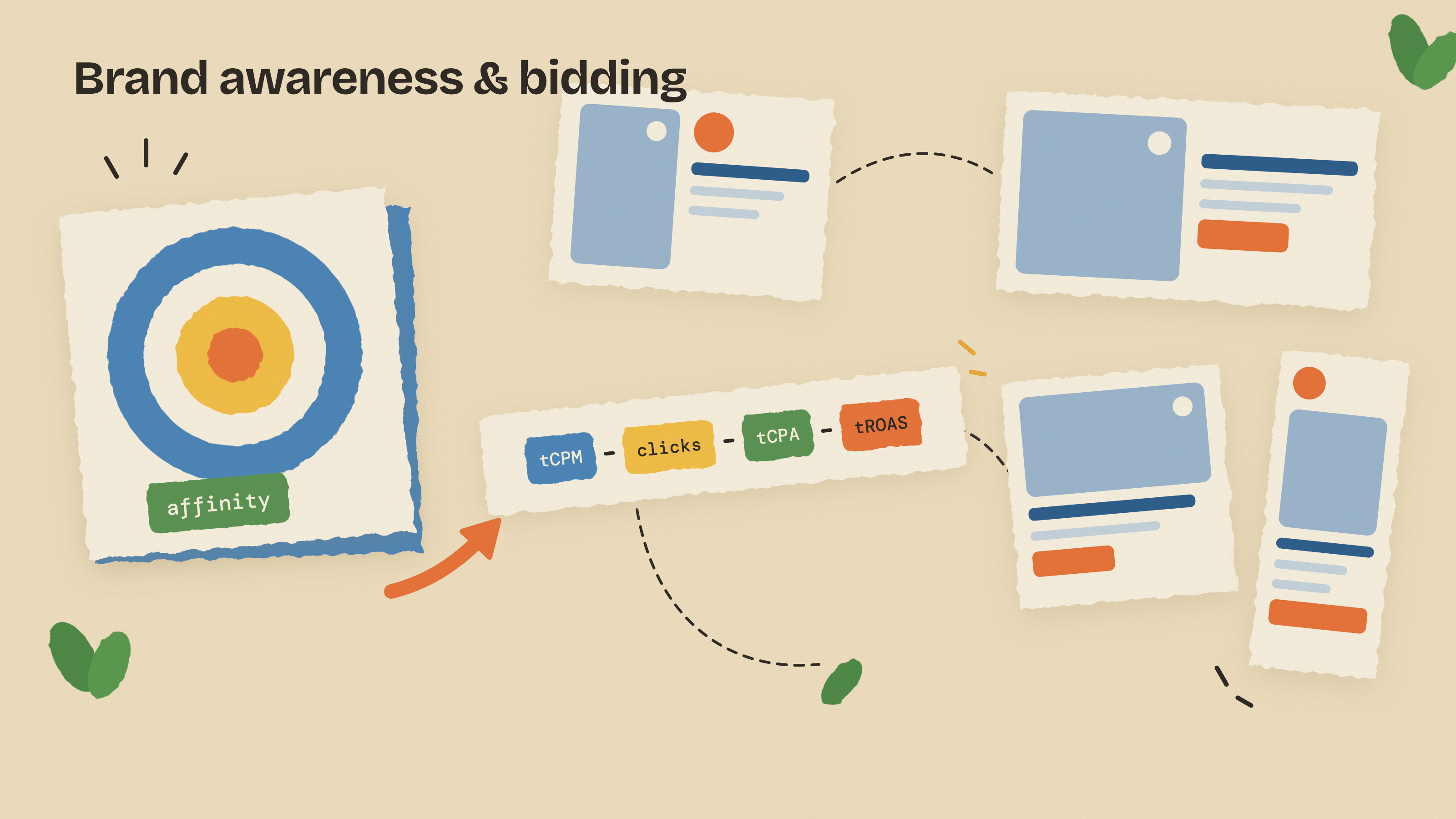
If you are wondering which targeting option is best for achieving brand awareness in Google Ads, the short answer is audience targeting, and specifically affinity segments: people grouped by their long-term passions, habits and interests. Pair them with a reach-focused bid strategy such as target CPM or viewable CPM on Display, Video or Demand Gen campaigns, and you pay to be seen by the right people rather than to win clicks from people who already know you.
That is also the answer Google's certification exams expect. Below: why, plus bidding, responsive display ads, SEO vs PPC and hiring an SEM agency.
Which targeting option is best for achieving brand awareness?
Brand awareness means reaching likely customers before they search for what you sell. A keyword only fires when someone is already looking, so awareness needs targeting built around who people are, not what they typed.
Google's page About audience segments lays out the options. Here is how each one lines up with the funnel:
| Audience segment | Who it reaches | Best funnel stage |
|---|---|---|
| Affinity segments | People with a strong, lasting interest, such as foodies, cricket fans or travel buffs | Awareness |
| Custom segments | People defined by keywords, URLs and apps you supply | Awareness or consideration, depending on the campaign goal |
| Life events | People moving house, getting married or graduating | Awareness and consideration (smaller reach than affinity) |
| In-market segments | People actively researching a purchase like yours | Consideration and conversion |
| Your data (remarketing, Customer Match) | People who already visited your site or app, or are on your customer list | Conversion and repeat sales |
Google describes in-market segments as built for advertisers who want conversions from likely buyers, which is the opposite of an awareness job. Affinity segments, on the other hand, reach people based on what they are passionate about. That is why affinity is the textbook answer, with custom segments as a close second when the ready-made affinity lists are too broad for your niche.
Targeting is only half the answer
The campaign type and bid strategy matter just as much. In Google's campaign objectives documentation, the old "Awareness and consideration" objective has been renamed "YouTube reach, views, and engagements" for new campaigns, and it is available for Display, Demand Gen and Video campaigns. Its stated aim is to increase awareness of your products or services. Google's audience page also notes that target frequency, a setting for video campaigns, is designed to increase brand awareness among the audience you pick.
So a sensible awareness setup for an Indian brand looks like this:
- Campaign: Video (YouTube) or Display, or Demand Gen if you have strong visuals.
- Targeting: one or two affinity segments, plus a custom segment built from competitor and category keywords.
- Bidding: target CPM (optimises for unique reach) or viewable CPM, not cost per click.
- Measurement: reach, frequency, view rate and a lift in branded searches, not last-click sales.
Types of bidding in Google Ads
A bid strategy tells Google what you are willing to pay for and what you want back. Google groups them by goal in its guide to choosing a bid strategy based on your goals: conversions, clicks, visibility and video views. Broadly, there are two types of bidding.
Manual bidding
Manual CPC lets you set the maximum cost per click yourself, keyword by keyword or ad group by ad group. It gives full control and full responsibility. It suits small accounts with tight budgets, new campaigns with no conversion history, or anyone learning how auctions behave. Viewable CPM (vCPM) is also manual: you set the most you will pay per 1,000 viewable impressions on the Display Network.
Automated bidding
With automated bidding, Google sets the bid for you in each auction, chasing the goal you choose. The strategies that optimise for conversions or conversion value are called Smart Bidding. These are the ones you will meet most often:
- Maximize clicks: gets as many clicks as possible within your budget.
- Maximize conversions: gets as many conversions as possible while spending the full budget, with no cost target.
- Target CPA: gets conversions while aiming for an average cost per acquisition you set.
- Maximize conversion value: gets the highest total conversion value (revenue) within budget.
- Target ROAS: gets conversion value while aiming for a return on ad spend you set.
- Target impression share: bids to show your ad at the absolute top, the top, or anywhere on the Search results page, a set percentage of the time.
- Target CPM (tCPM): sets an average cost per 1,000 impressions and optimises for unique reach.
One note on keywords: bidding works together with match types. If you are new to broad, phrase and exact match, read our guide to keyword match types and keyword research first, because a Smart Bidding strategy on badly chosen keywords still spends money on the wrong searches.
Match each auto bidding strategy to the right campaign goal
This is a favourite certification question and the most practical decision in any account. Use this table as your cheat sheet.
| Campaign goal | Bid strategy | Use it when |
|---|---|---|
| Website traffic (clicks) | Maximize clicks | You want visitors and have no conversion tracking yet |
| Control over click costs | Manual CPC | Small budget, testing, or you need keyword-level control |
| Conversions, spend the full budget | Maximize conversions | Tracking is live and you want volume within a fixed budget |
| Conversions at a set cost | Target CPA | You know what a lead or sale is worth, for example ₹400 per enquiry |
| Revenue, spend the full budget | Maximize conversion value | Orders have different values and you pass those values to Google |
| Revenue at a set return | Target ROAS | Ecommerce with reliable value data, for example a 400% ROAS target |
| Visibility on Search | Target impression share | Brand terms, or you must appear above competitors |
| Brand awareness and reach | Target CPM or viewable CPM | Display, Video or Demand Gen campaigns built to be seen |
| Video views | CPV or target CPV | YouTube campaigns where a view or interaction is the goal |
The ₹400 and 400% figures are illustrations. Set your own from margins: if a ₹2,000 order leaves ₹600 profit, a Target CPA above ₹600 loses money.
A common progression for a new Indian account is Maximize clicks or Manual CPC in month one, Maximize conversions once tracking records real leads, then Target CPA or Target ROAS when you have a few weeks of steady conversion data. Jumping straight to a tight target with no history usually starves the campaign of impressions.
What are two benefits of automated bidding?
The exam phrasing is "what are two benefits of automated bidding, choose two", and the answers come straight from Google's page About automated bidding:
- It saves time and removes guesswork. Google says automated bidding takes the heavy lifting and guesswork out of setting bids, and there is no need to manually update bids for specific ad groups or keywords.
- It bids smarter, in every auction. Smart Bidding uses auction-time bidding, setting a bid for every query, and factors in a wide range of auction-time signals such as device, location, time of day and language, using AI to tailor the bid to each auction.
The catch: automated strategies learn from your data. If conversion tracking is broken, or counts page views as leads, the algorithm optimises perfectly towards the wrong thing.
Responsive display ads, explained simply
Responsive display ads are the default ad format for Display campaigns. Instead of designing a dozen banner sizes, you upload a set of assets: images, logos, headlines, descriptions and optionally videos. According to Google's page About responsive display ads, Google AI then generates ad combinations for websites, apps, YouTube and Gmail, picking the best mix of assets for each ad slot based on performance.
What's a characteristic of responsive display ads?
Their defining characteristic is that they adapt automatically. Google adjusts the size, appearance and format of your ads to fit just about any available ad space. The same set of assets can appear as a large image banner on a news site in one place and as a simple text ad inside an app in another.
What's one benefit of using responsive display ads?
If you only remember one, remember broader reach: because the ad reshapes itself, it qualifies for far more placements than a fixed-size banner. Google lists other benefits too:
- Optimisation: Google AI tests combinations and leans towards the strongest ones.
- Efficiency: fewer ads to build and manage per ad group, so you spend more time on strategy than resizing creatives.
- Video and feeds: videos replace images when Google predicts better results, and a product feed enables dynamic product ads.
What's provided by responsive display ads?
In plain terms, responsive display ads provide automated ad creation: you supply the raw material, and Google provides the finished ads in whatever shape each placement needs, chosen by machine learning. Google may also add asset enhancements, stock images or AI-generated assets unless you control those settings, so check your account's asset options before launch if brand consistency matters.
The assets you need
Google's create a responsive display ad guide lists these core specs:
| Asset | Requirement |
|---|---|
| Landscape image (1.91:1) | 1200 x 628 recommended, minimum 600 x 314, max 5,120 KB |
| Square image | 1200 x 1200 recommended, minimum 300 x 300, max 5,120 KB |
| Landscape logo (4:1) | 1200 x 300 recommended, minimum 512 x 128 |
| Square logo | 1200 x 1200 recommended, minimum 128 x 128 |
| Short headlines | 1 to 5, each 30 characters or fewer |
| Long headline | 90 characters or fewer |
| Descriptions | 1 to 5 |
| Business name and video | Business name required; YouTube video optional |
Give Google variety: three or four genuinely different images, and headlines that work alone, since any one may appear without the others. A good-looking, fast landing page design matters just as much, since a display click that lands on a slow, confusing page is wasted money.
A worked example: awareness to sales for a Nagpur sweet shop
Imagine a Nagpur mithai brand launching Diwali gift boxes on a ₹30,000 monthly budget. The split is illustrative, not a formula.
- Awareness (about ₹10,000): a Video or Display campaign with responsive display ads, targeting a food-related affinity segment plus a custom segment built from searches like "Diwali gift hampers" and competitor names, limited to Nagpur and nearby cities. Bid with target CPM.
- Consideration (about ₹8,000): Display or Demand Gen aimed at in-market segments for gifts and occasions, plus remarketing to people who watched the video or visited the site.
- Conversion (about ₹12,000): Search campaigns on high-intent keywords such as "sweet box delivery Nagpur", starting on Maximize conversions, with a separate brand campaign on Target impression share so nobody else takes your name.
Judge each layer by its own job: awareness on reach and branded search growth, Search on cost per order. The Corart case study shows what tightening the conversion layer can do: ROAS moved from 1.6x to 4.4x and cost per lead fell from ₹540 to ₹260.
SEO vs. PPC: when to use each
PPC buys visibility now; SEO earns it over time. One does not buy the other: Google's guide on hiring an SEO states that advertising with Google won't have any effect on your site's presence in its search results, and that Google never accepts money to include or rank sites.
| Factor | SEO | PPC |
|---|---|---|
| Speed | Slow; usually months before meaningful traffic | Fast; ads can run the day they are approved |
| Cost model | Content, technical work and time; clicks are free | You pay for every click or impression |
| When spend stops | Rankings fade slowly | Traffic stops almost immediately |
| Best for | Evergreen demand, informational searches, local discovery | Launches, seasonal offers, testing, competitive commercial terms |
Use PPC for leads this month, new product or city tests, and seasons like Diwali. Use SEO for year-round searches and a channel that compounds. Most growing Indian businesses run both: ads to fill the pipeline today, SEO so they are not renting all their traffic forever. If organic is your gap, start with why your site may not be showing on Google, and compare what SEO packages for small business include at each price.
What to expect from an SEM agency or SEM specialist
Search engine marketing agencies and freelance SEM specialists vary wildly in India. A good SEM advertising agency should give you:
- Conversion tracking before spend. Calls, forms, WhatsApp clicks and purchases tracked properly, because every automated bid strategy depends on it.
- A goal-to-strategy plan. Which campaigns serve awareness, which serve conversions, and which bid strategy each uses, in writing.
- Account ownership in your name. The Google Ads account and billing should belong to you, with the agency added as a user.
- Reporting on business results. Cost per lead, cost per sale or ROAS, not just impressions and clicks.
- Search term and placement hygiene. Regular negative keywords and exclusions so budget is not leaking to irrelevant searches or junk apps.
- Clear fees, separate from ad spend. You should always know what goes to Google and what goes to the agency.
Red flags among SEM agencies: guaranteed "first position" or guaranteed lead numbers, refusal to share account access, and fees hidden inside the ad budget. For a benchmark of real results, the Stone & Acres case study shows cost per qualified lead falling from ₹2,400 to ₹1,490. If you are comparing local options, our list of the top digital marketing companies in Nagpur is a useful starting point.
Getting started
Start with the goal, then pick the targeting and bid strategy that serve it: affinity audiences and CPM bidding for awareness, in-market and remarketing for consideration, and Smart Bidding on Search for conversions. If you would rather have a specialist run it, our Google and Meta ads management starts at ₹8,000 a month plus ad spend, and you can see every package on our pricing page or talk to the digital marketing team in Nagpur about your account.
Frequently asked questions
Which targeting option is best for achieving brand awareness?
Audience targeting, specifically affinity segments, which reach people based on their passions, habits and long-term interests. Custom segments built from your own keywords and URLs are a strong alternative. In-market segments are better for conversions because they target people already close to buying.
How do you match each auto bidding strategy to the right campaign goal?
Use Maximize clicks for website traffic, Maximize conversions or Target CPA for leads and sales, Maximize conversion value or Target ROAS for revenue, Target impression share for visibility on Search, and target CPM or viewable CPM for brand awareness and reach. For video views, use CPV or target CPV.
What are two benefits of automated bidding?
First, it saves time and removes guesswork, because you no longer update bids by hand for each keyword or ad group. Second, Smart Bidding uses auction-time bidding, setting a bid for every query based on a wide range of signals such as device, location and time of day.
What's a characteristic of responsive display ads?
They automatically adjust their size, appearance and format to fit just about any available ad space. You upload images, logos, headlines and descriptions, and Google AI assembles them into ads for websites, apps, YouTube and Gmail.
What's one benefit of using responsive display ads?
Broader reach: because one set of assets can reshape itself into many formats, the ads qualify for far more placements than fixed banners. They also save time, since you manage fewer ads per ad group while Google tests the best asset combinations.
What are the main types of bidding in Google Ads?
There are two types: manual bidding, such as Manual CPC and viewable CPM, where you set bids yourself, and automated bidding, where Google sets bids for your goal. Automated options include Maximize clicks, Maximize conversions, Target CPA, Maximize conversion value, Target ROAS, Target impression share and target CPM.
Shubham N Datarkar
Founder, Timewheel
Shubham founds and leads Timewheel, a Nagpur product studio that builds its own software and runs SEO, AI-search and growth for businesses across India. He writes from hands-on work shipping products and measuring what actually moves rankings and revenue.
Comments
Be the first to comment.