The marketing and advertising difference is one of scope. Marketing is the whole job of deciding what to sell, to whom, at what price, through which channels and with what message. Advertising is one paid tool inside that job: the part where you buy space or time (a newspaper ad, an Instagram reel boost, a Google search ad) to carry your message to people.
So every advert is marketing, but most marketing is not advertising. A clear product, a fair price, a stocked shelf at the right kirana store and a quick WhatsApp reply to a customer are all marketing decisions, and none of them needs an ad budget.
The marketing and advertising difference, side by side
The American Marketing Association defines marketing as the activity, institutions and processes for creating, communicating, delivering and exchanging offerings that have value for customers, partners and society (AMA's definition of marketing). Look at the verbs. Only one of them, communicating, overlaps with advertising, and advertising is only one way to communicate. The same AMA page lists TV, radio and digital display advertising as examples of outbound marketing, which places advertising inside marketing, not beside it.
| Point | Marketing | Advertising |
|---|---|---|
| Scope | Product, price, place, promotion, service, research | Paid messages in media, one part of promotion |
| Question it answers | What should we sell, to whom, and how will they buy it? | How do we get this message in front of these people? |
| Time frame | Ongoing, shapes the business over years | Campaign based, runs for days, weeks or a season |
| Cost | Often time and thinking more than cash | Media spend plus creative production |
| Typical tools | Customer research, pricing, packaging, distribution, SEO, reviews, after-sales service | Google Ads, Meta ads, newspaper inserts, FM radio, hoardings, YouTube pre-roll |
| What happens if you stop | The business loses direction | Paid reach stops the same day |
The last row matters most. Paused ads mean paused leads, while marketing basics such as a good website, search visibility and reviews keep paying for longer.
An Indian small-business example
Take a hypothetical home bakery in Nagpur that sells custom cakes. Here is how the same business looks when you separate marketing from advertising.
- Marketing decisions: focusing on birthday cakes for families within 8 km, a price that covers ingredients and delivery, Swiggy and Zomato listings plus WhatsApp orders, a Google Business Profile and directory listings, sturdy packaging, and asking happy customers for reviews.
- Advertising decisions: a ₹300 a day Instagram ad to nearby pin codes, a Google search ad for "custom cake near me", and a newspaper insert before Diwali. This is the slice a digital marketing agency usually runs.
If the cakes arrive squashed, ads only speed up the bad reviews. Fix product, price and delivery first and every rupee of advertising works harder. A real example of this sequencing is our Occasion Cakes case study, where local SEO and Google Business Profile work lifted online orders from about 70 to 218 a month over five months.
The 4 Ps of marketing
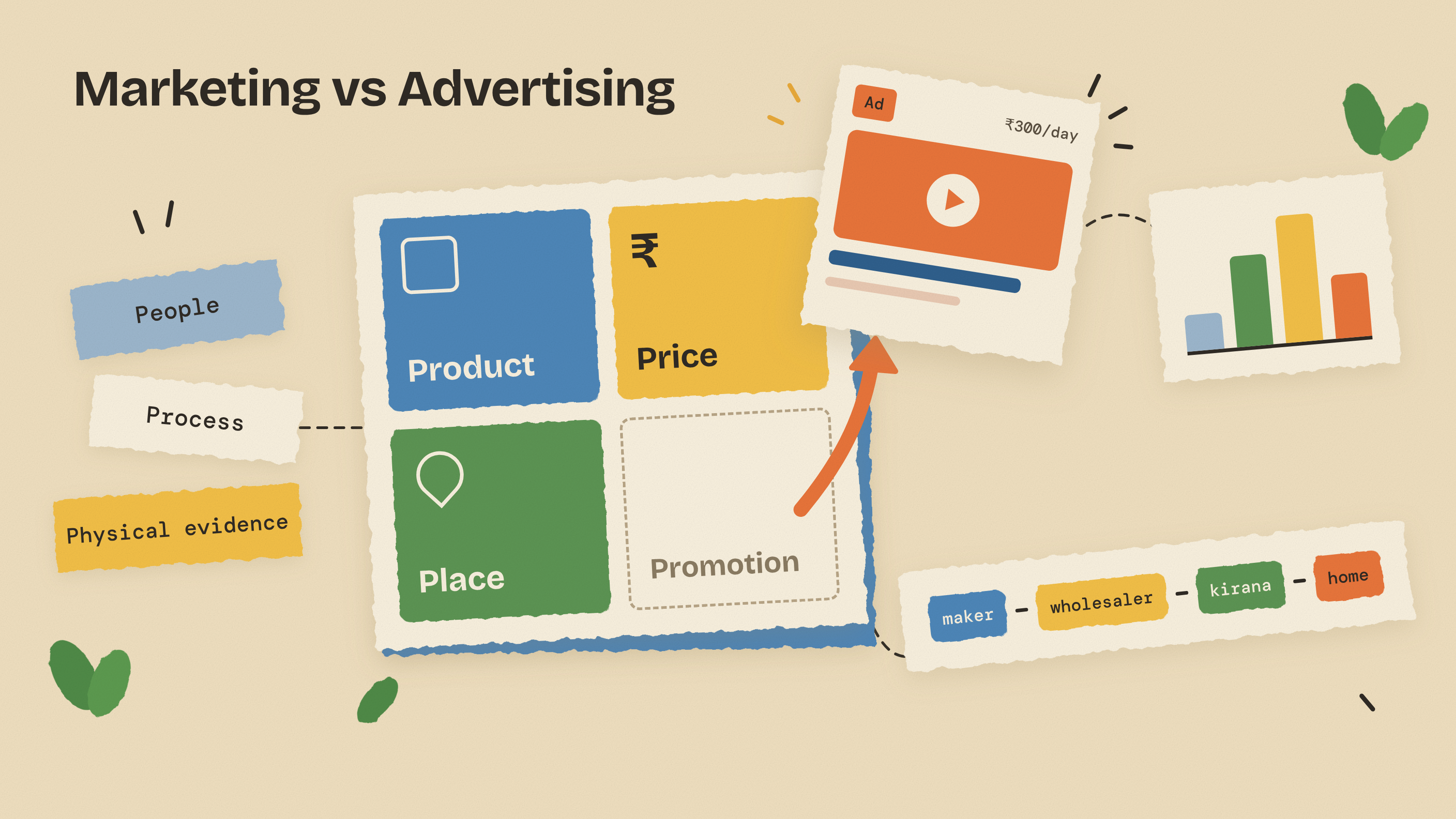
The 4 Ps, popularised by E. Jerome McCarthy in 1960, are the simplest way to see why advertising is only a slice of marketing. Advertising lives inside one P out of four.
- Product: what you sell, including quality, variants and packaging.
- Price: list price, discounts, EMI options and how you compare.
- Place: where customers buy: your shop, website, Amazon, Flipkart, distributors.
- Promotion: advertising, PR, offers, content, social media and word of mouth.
Before raising the promotion budget, check the other three Ps. Low sales are often a place or price problem, and more ads fix neither.
The 7 Ps of services, and the "4 Ps of service strategy"
Services are harder to market than products because you cannot hold them, store them or inspect them before buying. In 1981 Bernard Booms and Mary Jo Bitner added three Ps to the original four for service businesses, giving the 7 Ps that most Indian business schools now teach:
- People: the staff who deliver the service. A rude receptionist at a clinic undoes good advertising.
- Process: how the service is delivered, from booking to payment to follow-up. Fewer steps usually means fewer drop-offs.
- Physical evidence: the visible proof of quality: a clean salon, a well-made website, uniforms, invoices, reviews.
A salon, for example, can improve process with online booking (our own product Book A Sloth does this), people with staff training, and physical evidence with before and after photos and reviews.
What are the 4 Ps of service strategy?
People who search for the "4 Ps of service strategy" usually mean one of two things, and it helps to know which one your course or interviewer has in mind.
- In marketing classes, it is a loose way of asking how the 4 Ps apply to a service business, and the honest answer is the 7 Ps above: the original four plus people, process and physical evidence.
- In IT service management (ITIL v3), the Service Strategy stage uses four Ps of strategy borrowed from management writer Henry Mintzberg: Perspective (the vision and direction), Position (how you stand against competitors), Plan (the concrete route to your goals) and Pattern (the consistent decisions and behaviour that show your real strategy over time).
The ITIL version is a useful sanity check: if your position is "cheapest in town" but your pattern is adding premium services, your advertising will be confused too.
The 9 Ps of marketing: why every list is different
Here is the honest part: there is no single official list of 9 Ps. The 4 Ps and 7 Ps have clear origins; beyond seven, writers add two extras that suit their argument, commonly picked from packaging, positioning, partnerships, profit, purpose and performance.
For an exam, use your textbook's list. For a business, the 7 Ps plus positioning and profit cover most of what matters.
What are the 4 Ps of design?
This phrase also has more than one meaning, and sources disagree. The two you will meet most often are:
- ITIL service design: People, Processes, Products and Partners. Products here means the tools and technology needed to deliver a service, and partners are vendors and suppliers (Lucid's overview of ITIL service design explains each). This is the version most cited in business and IT courses, and it is close to the "people, process, product, place" wording some people remember.
- Creativity and design thinking: Person, Process, Press and Product, from psychologist Mel Rhodes' 1961 analysis of creativity. "Press" means the environment or pressure around the creative work.
Before launching a new service, ask whether you have the people, process, tools and partners to deliver what your ads will promise.
Distribution channels and why they matter in marketing
A distribution channel is the route a product takes from the maker to the buyer. It is the "place" in the 4 Ps, and in India it is often the P that decides whether a brand survives. A great product with a strong ad campaign still fails if the customer walks into the shop and it is not on the shelf.
The importance of distribution channels in marketing comes down to five things:
- Reach: no small manufacturer can supply lakhs of retail outlets directly; intermediaries can.
- Cost: each layer takes a margin, which shapes your final price and profit.
- Control: shorter channels keep more control over pricing, display and customer data.
- Credit: wholesalers often extend credit to retailers, which a small brand cannot afford alone.
- Ad efficiency: a state-wide campaign wastes money if you are stocked in only two cities.
Channel levels: from direct to two-level and beyond
Marketing textbooks count channel levels by the number of middlemen between the manufacturer and the consumer.
| Channel | Route | Indian example |
|---|---|---|
| Zero level (direct) | Manufacturer to consumer | A D2C brand selling on its own Shopify site, a farmer at a weekly bazaar |
| One level | Manufacturer to retailer to consumer | A furniture maker supplying a few large showrooms |
| Two level | Manufacturer to wholesaler to retailer to consumer | A namkeen or masala brand sold through wholesalers to kirana stores |
| Three level | Manufacturer to agent or super stockist to wholesaler to retailer to consumer | National FMCG brands reaching small towns and villages |
The two-level channel of distribution, with an example
A two-level channel of distribution has two intermediaries: a wholesaler and a retailer. Picture a small spice maker in Nagpur:
- Manufacturer: grinds and packs turmeric and garam masala.
- Wholesaler: a trader in a market such as Itwari buys in bulk and sells smaller lots, often on credit.
- Retailer: kirana stores across Nagpur buy a few cartons at a time.
- Consumer: the household buys one pack at the corner shop.
The spice maker gives up margin at each step but gains outlets it could never reach with its own van. So its promotions should help the retailer sell (shelf strips, a counter display, a trade scheme) as much as they speak to consumers. Many such brands also run a direct channel through a Shopify store or marketplaces.
The importance of product life cycle and brand life cycle
The product life cycle describes how sales of a product category typically move through four stages: introduction, growth, maturity and decline. Harvard marketing professor Theodore Levitt argued back in 1965 that most executives knew the idea but rarely used it to plan, and that using it deliberately could become a competitive advantage (Levitt's "Exploit the Product Life Cycle" in HBR). That point still holds, because the right marketing mix changes at each stage.
| Stage | What is happening | Marketing focus | Role of advertising |
|---|---|---|---|
| Introduction | Few buyers, high cost per sale | Explain the product, win early adopters, get the channel to stock it | Awareness and education, often targeted and small |
| Growth | Sales rising, competitors arrive | Widen distribution, build preference, add variants | Scale what works, build the brand |
| Maturity | Sales flatten, price pressure | Defend share, improve service, find new uses or segments | Reminder and loyalty, stronger emotional work |
| Decline | Demand falls | Cut costs, harvest, refresh or retire | Minimal, focused on loyal customers |
The importance of product life cycle thinking is that it stops you using the wrong tool at the wrong time: heavy discounting in the introduction stage, for instance, or launch-style awareness ads for a mature product everyone already knows.
Brand life cycle
The brand life cycle applies a similar idea to the brand rather than one product: a brand is launched, grows its recognition, matures and then either declines or is revitalised. There is no single standard model, but the key point is that a brand can outlive many products, as long-running Indian biscuit, soap and tea brands show by refreshing packaging and messaging for each generation. For a small business, protect the name through consistent quality, reviews and a recognisable look, because that asset carries over when products change.
The power of emotional marketing
Emotional marketing builds your message around feelings such as security, belonging, pride and care for family, rather than only features and prices.
The evidence is stronger than a gut feeling. In Harvard Business Review, Scott Magids, Alan Zorfas and Daniel Leemon describe how brands that targeted customers' emotional motivators saw measurable gains. One bank built a credit card for millennials around emotional connection, and use among that segment rose 70% while new account growth rose 40% ("The New Science of Customer Emotions", HBR). The same article reports an apparel retailer more than tripling its same-store sales growth after reorienting around its most emotionally connected customers.
The UK's Institute of Practitioners in Advertising has also published long-running effectiveness research by Les Binet and Peter Field on the tension between short-term response and long-term brand building (IPA's "The Long and the Short of It"). The practical message for a small business is to avoid judging everything by this week's clicks: a share of your effort should build memory and feeling, not only immediate sales.
How Indian small businesses can use emotion without being cheesy
- Find the real feeling. A parent choosing a coaching class buys confidence about their child's future, not "experienced faculty".
- Show real people. A reel of a customer's reaction to a birthday cake beats a stock photo.
- Go local, honestly. Marathi or Hindi captions and festival stories, when they fit.
- Back it with proof. Reviews and clear prices keep the feeling believable.
Emotion earns attention and preference; facts close the sale, especially in search ads where people compare options. Our guide to Google Ads bidding and responsive display ads covers the paid side, and a social media marketing plan is usually where emotional brand stories live day to day.
Putting marketing and advertising together: a simple checklist
Use this order before you spend a rupee on ads: marketing first, advertising on top.
- Product and positioning: who is it for, and why is it better?
- Price: does it cover costs, channel margins and GST?
- Place: can people buy it where your ads will reach them?
- Service readiness: are people, process and physical evidence ready for more customers?
- Life cycle stage: are you educating, scaling or defending?
- Free visibility: Google Business Profile, a fast website and basic SEO.
- Advertising: start small, track cost per lead, scale what works.
When the basics are right, ads compound. In our Corart case study, ROAS rose from 1.6x to 4.4x, and in Stone and Acres cost per qualified lead fell from ₹2,400 to ₹1,490, through fixing targeting, landing pages and offers together.
If you want help with the advertising part once your marketing basics are in place, our digital marketing service for Google and Meta ads starts at ₹8,000 a month plus ad spend, and you can compare every service on our pricing page or book a call to talk through which part of your marketing mix to fix first.
Frequently asked questions
What is the difference between marketing and advertising?
Marketing covers everything from product and pricing to distribution, service and promotion. Advertising is one part of promotion: paid messages placed in media such as Google, Instagram, newspapers or FM radio. Marketing decides what to say and to whom; advertising pays to say it.
What are the 4 Ps of service strategy?
In marketing, people usually mean how the 4 Ps apply to services, which is answered by the 7 Ps: product, price, place, promotion, people, process and physical evidence. In ITIL IT service management, the 4 Ps of service strategy are perspective, position, plan and pattern.
What are the 4 Ps of design?
The most cited version, from ITIL service design, is people, processes, products and partners. In creativity and design thinking, the 4 Ps are person, process, press and product, from Mel Rhodes' 1961 work. Check which context your course or source uses.
What are the 9 Ps of marketing?
There is no single agreed list. Most versions start with the 7 Ps of services and add two more, such as packaging, positioning, partnerships, profit, purpose or performance. Use the list from your textbook or source when answering an exam question.
What is a two-level channel of distribution?
It is a route with two intermediaries: the manufacturer sells to a wholesaler, the wholesaler sells to retailers, and retailers sell to consumers. It is common for FMCG products in India such as spices, snacks and soaps sold through kirana stores.
Why is the product life cycle important in marketing?
Each stage (introduction, growth, maturity, decline) needs a different mix. Introduction needs education and distribution, growth needs scale, maturity needs defence and loyalty, and decline needs cost control. Knowing the stage stops you using the wrong tactic at the wrong time.
Shubham N Datarkar
Founder, Timewheel
Shubham founds and leads Timewheel, a Nagpur product studio that builds its own software and runs SEO, AI-search and growth for businesses across India. He writes from hands-on work shipping products and measuring what actually moves rankings and revenue.
Comments
Be the first to comment.